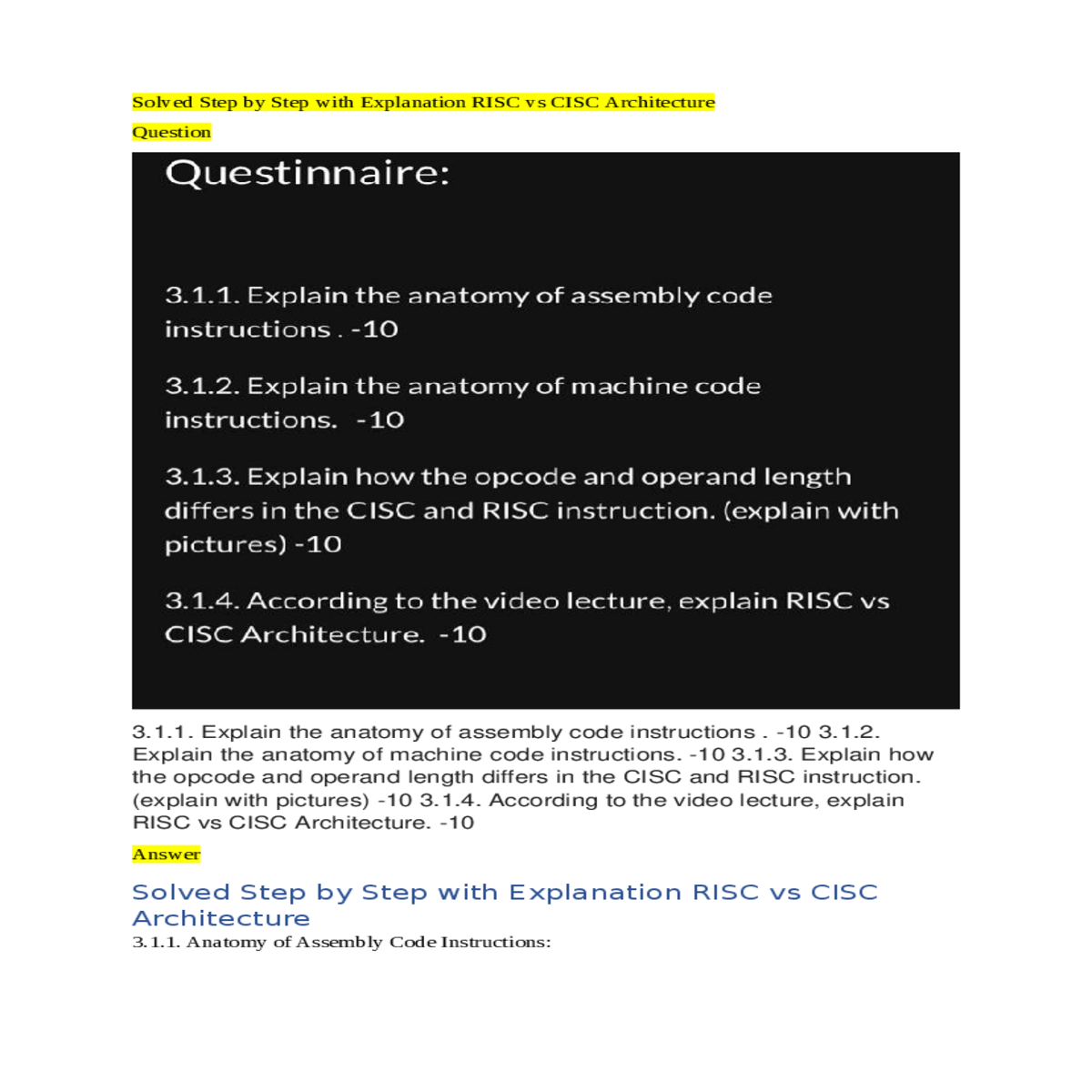
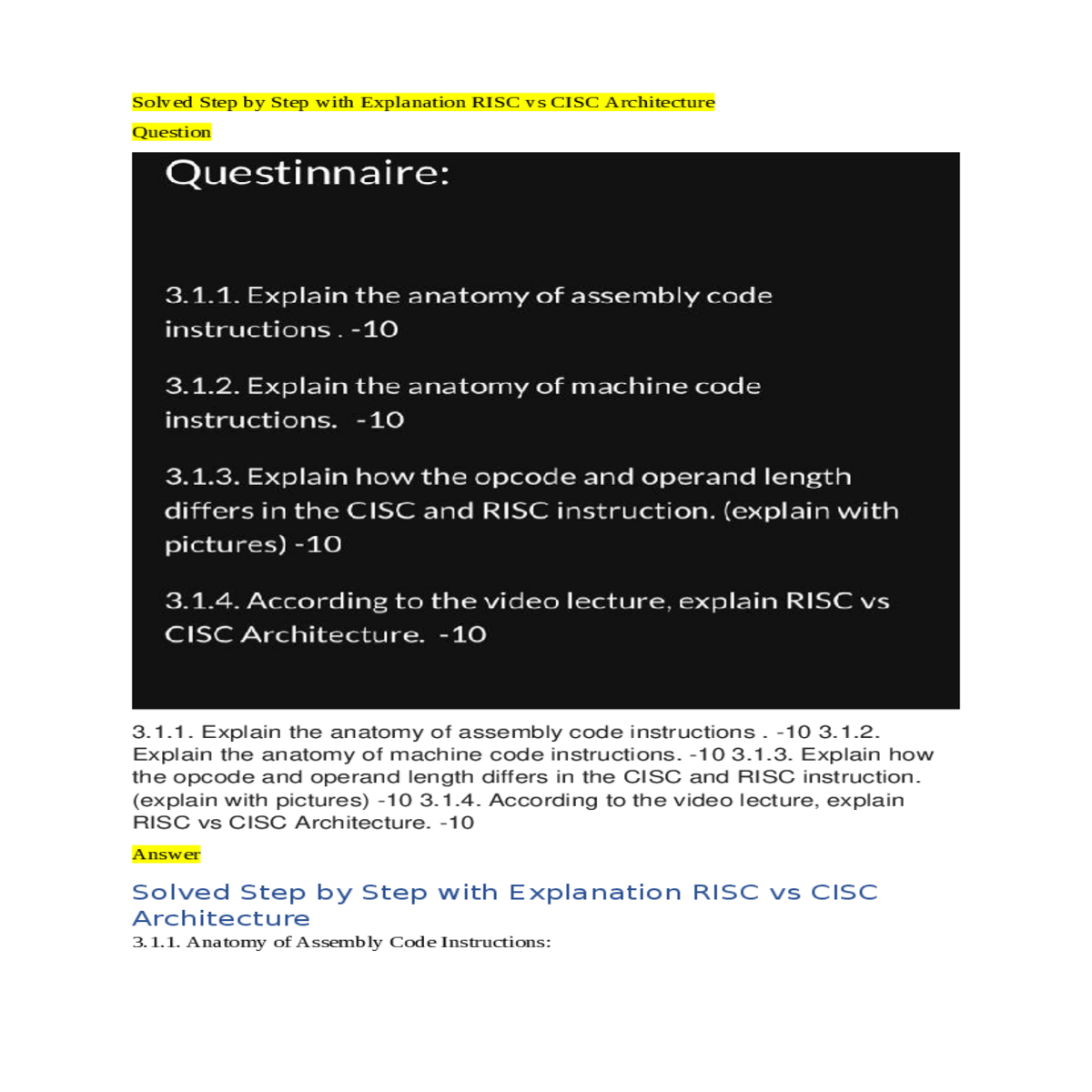
Explain how the opcode and operand length differs the cisc and risc instruction
Solved Step by Step with Explanation RISC vs CISC Architecture
Question
Solved Step by Step with Explanation RISC vs CISC Architecture
Assembly code instructions have a basic structure that consists of an operation code (opcode) and one or more operands. The opcode specifies the operation to be performed, and the operands provide the data or addresses on which the operation is performed.
For example, in the assembly instruction `ADD R1, R2`, "ADD" is the opcode, and "R1" and "R2" are the operands. This instruction would add the contents of register R2 to the contents of register R1.
Opcode: 0010 (4 bits)
Operand 1: 1010 (4 bits)
CISC (Complex Instruction Set Computer) and RISC (Reduced Instruction Set Computer) architectures have different approaches to opcode and operand lengths:
CISC:
- RISC architectures promote simpler instructions, which means that most operations are carried out by a single instruction without the need for complex addressing modes.
- RISC instructions tend to have a smaller opcode portion, as more of the instruction's complexity is moved into the operands.
- RISC processors rely on compiler optimization to produce efficient code sequences.
- The emphasis is on optimizing hardware for simple instructions and pipelining.
- The emphasis is on providing a rich set of instructions that can perform complex tasks in a single instruction.
It's important to note that the distinction between RISC and CISC has become somewhat blurred in modern architectures, as many processors now incorporate features of both to optimize performance.