

Error bookmark notdefined data
Business, Accounting and Finance

1 | P a g
e

|
|
||
|---|---|---|---|
| Data ............................................................................. | |||
Activity 1 .................................................................................................. Error! Bookmark not
defined.
Activity 2 22
|
|---|
| Monitor | and document effectiveness of learning activities ............................................................. | |
|---|---|---|
Activity 5 58
2 | P a g
|
|---|
Ensure implementation of policies and procedures for the information or knowledge
|
||
|---|---|---|
| and Techniques .......................................................................... | ||
|
|---|
Activity 8 125
ASSESSMENT….......................................................................................................................................................140
3 | P a g
|
|||
|---|---|---|---|
| information | or |
|
|
It applies to individuals who are responsible for seeing that key information and corporate knowledge are retained, accessible to others and improve business outcomes.
The unit applies to information or knowledge management systems which comprise policies, protocols, procedures and practices to manage information or knowledge within the organisation and among relevant stakeholders.
Foundation Skills
|
||||||
|---|---|---|---|---|---|---|
|
|
|
||||
|
||||||
|
||||||
|
Unit Mapping Information
|
|
|---|
Assessment
requirements
personnel to use information or knowledge management system including
providing human, financial and physical resources as required
correct application of policies and procedures for the information or knowledge
management system
Knowledge Evidence
To complete the unit requirements safely and effectively, the individual must:
information management
customer service
management system
Introducing Knowledge Management
KM Strategy: Knowledge management strategy must be dependent on corporate strategy. The objective is to manage, share, and create relevant knowledge assets that will help meet tactical and strategic requirements.
Organisational Culture: The organisational culture influences the way people interact, the context within which knowledge is created, the resistance they will have towards certain changes, and ultimately the way they share (or the way they do not share) knowledge.
Typically, failed initiatives have often placed an undue focus on knowledge management tools and systems while neglecting the other aspects. This issue will also be addressed throughout the site, and particularly in the knowledge management strategy section.
At this point, the articles presented on this site focus on the first five dimensions. Originally, I had deemed the political dimension to be beyond the scope of this site, since it is not something that is commonly tackled in KM literature. However, I will add a section on the political aspect of KM in the future.
|
|---|

(HARVEST)
| | | ||||||
|---|---|---|---|---|---|---|---|
|
|
||||||
| | | ||||||
| | selection | of | |
|
support, | ||
|
|||||||
| |
|
||||||
practices
(HYPOTHESIZE) (HUNTING)This kind of simplistic view of knowledge was particularly widespread during the 90s when information technology became increasingly more common. However even today, some KM systems are little more than information management systems using knowledge as a virtual synonym for information.
To illustrate, Theirauf (1999) defines the three components as follows: data is the lowest point, an unstructured collection of facts and figures; information is the next level, and it is regarded as structured data; finally knowledge is defined as "information about information".
Defining Data, Information, and Knowledge
IT is usually invaluable in the capacity of turning data into information, particularly in larger firms that generate large amounts of data across multiple departments and functions. The human brain is mainly needed to assist in contextualization.
Knowledge: Knowledge is closely linked to doing and implies know-how and understanding. The knowledge possessed by each individual is a product of his experience, and encompasses the norms by which he evaluates new inputs from his surroundings (Davenport & Prusak 2000). I will use the definition presented by Gamble and Blackwell (2001), based closely on a previous definition by Davenport & Prusak:
Over the centuries many attempts have been made to classify knowledge, and different fields have focused on different dimensions. This has resulted in numerous classifications and distinctions based in philosophy and even religion. Though not directly related to our purpose here, the wikipedia article on knowledge provides some interesting background reading.
Within business and KM, two types of knowledge are usually defined, namely explicit and tacit knowledge. The former refers to codified knowledge, such as that found in documents, while the latter refers to non-codified and often personal/experience-based knowledge.
Below I present an overview of these three categories, as well as a short discussion on the way knowledge management systems (KMS) can/cannot be used to manage them.
Although this is changing to some limited degree, KM initiatives driven by technology have often had the flaw of focusing almost exclusively on this type of knowledge. As discussed previously, in fields such as IT there is often a lack of a more sophisticated definition. This has therefore created many products labeled as KM systems, which in actual fact are/were nothing more than information and explicit knowledge management software.
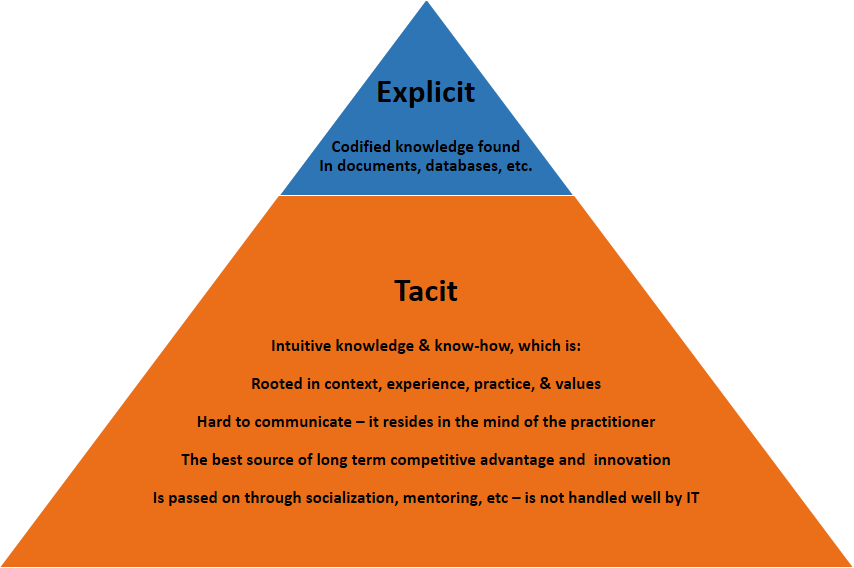
Explicit knowledge is found in: databases, memos, notes, documents, etc. (Botha et al. 2008)
Using a reference by Polanyi (1966), imagine trying to write an article that would accurately convey how one reads facial expressions. It should be quite apparent that it would be near impossible to convey our intuitive understanding gathered from years of experience and practice. Virtually all practitioners rely on this type of knowledge. An IT specialist for example will troubleshoot a problem based on his experience and intuition. It would be very difficult for him to codify his knowledge into a document that could convey his know-how to a beginner. This is one reason why experience in a particular field is so highly regarded in the job market.
The exact extent to which IT systems can aid in the transfer and enhancement of tacit knowledge is a rather complicated discussion. For now, suffice it to say that successful KM initiatives must place a very strong emphasis on the tacit dimension, focusing primarily on the people involved, and they must understand the limitations imposed by computerized systems.