Enclosing the charge gauss law and the symmetry the charge distribution
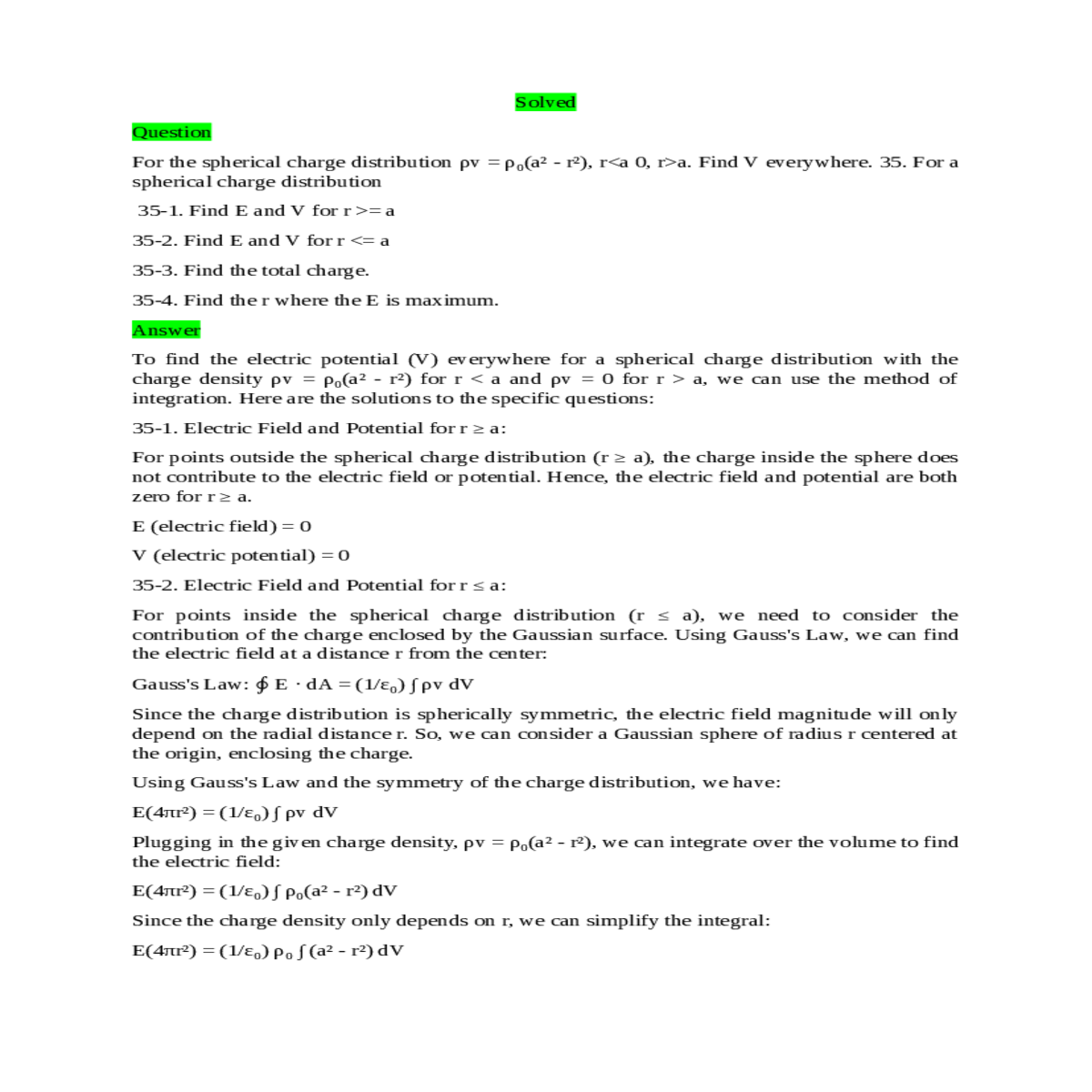
35-2. Find E and V for r <= a
35-3. Find the total charge.
For points outside the spherical charge distribution (r ≥ a), the charge inside the sphere does not contribute to the electric field or potential. Hence, the electric field and potential are both zero for r ≥ a.
E (electric field) = 0
Since the charge distribution is spherically symmetric, the electric field magnitude will only depend on the radial distance r. So, we can consider a Gaussian sphere of radius r centered at the origin, enclosing the charge.
Using Gauss's Law and the symmetry of the charge distribution, we have:
E(4πr²) = (1/ε₀) ρ₀ ∫ (a² - r²) dV
Integrating (a² - r²) over the volume element dV in spherical coordinates, we have:
E = (1/4πε₀) ρ₀ (a² - r²) / r²
The electric potential (V) is related to the electric field (E) by:
V = (ρ₀/8πε₀) [(2a²/r) - r]
35-3. Total Charge:
Integrating with respect to r, θ, and φ, we obtain:
Q = 4πρ₀ ∫ (a² - r²) r² sinθ dθ dφ dr
Evaluating the integrals, we find:
Q = (4/3) πρ₀a⁴
dE/dr = (1/4πε₀) ρ₀ (-2r/a²)
Setting this equal to zero, we find: