
Eccwc302a inclusive practice and principles in early childhood
ECCWC302A Inclusive Practice and Principles in Early Childhood
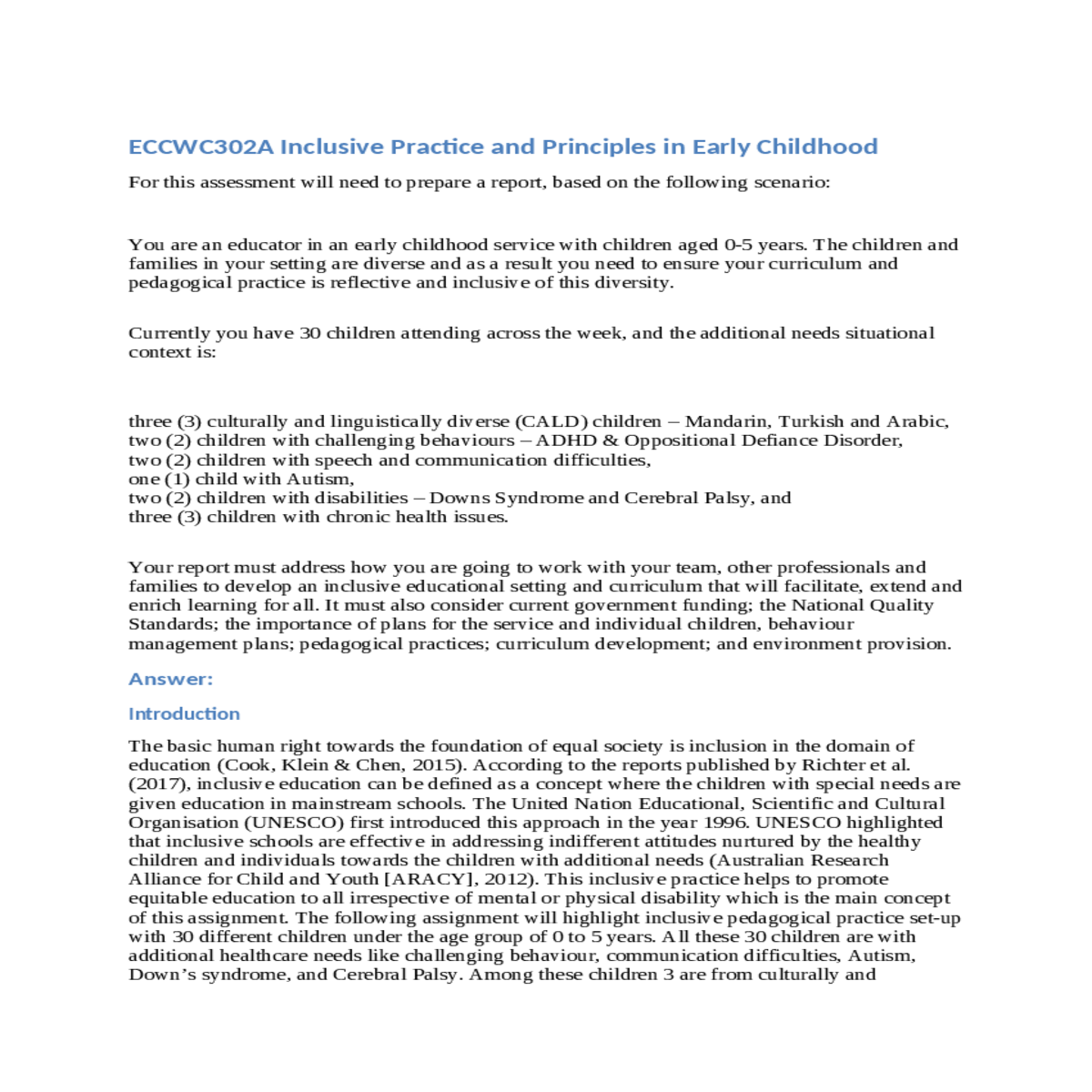
For this assessment will need to prepare a report, based on the following scenario:
Answer:
Introduction
The basic human right towards the foundation of equal society is inclusion in the domain of education (Cook, Klein & Chen, 2015). According to the reports published by Richter et al. (2017), inclusive education can be defined as a concept where the children with special needs are given education in mainstream schools. The United Nation Educational, Scientific and Cultural Organisation (UNESCO) first introduced this approach in the year 1996. UNESCO highlighted that inclusive schools are effective in addressing indifferent attitudes nurtured by the healthy children and individuals towards the children with additional needs (Australian Research Alliance for Child and Youth [ARACY], 2012). This inclusive practice helps to promote equitable education to all irrespective of mental or physical disability which is the main concept of this assignment. The following assignment will highlight inclusive pedagogical practice set-up with 30 different children under the age group of 0 to 5 years. All these 30 children are with additional healthcare needs like challenging behaviour, communication difficulties, Autism, Down’s syndrome, and Cerebral Palsy. Among these children 3 are from culturally and linguistically diverse communities and another 3 are suffering from chronic health issues. The assignment will initiate with funding and national quality standards in Australia for inclusive pedagogical practice. After discussing the issue, the assignment will highlight the organisational and professional support helpful in setting up diverse set-up and special skills required by an educator in order to successfully adapt under this diverse set-up. The succinct discussion of all these points will help to analyse the importance of inclusion and how this inclusive practice can be applied on diverse settings.
Current Funding
According to the New South Wales (NSW) Department of Education (2018), the disability and inclusive program helps to generate support finding and to help children with special needs in community to take part in early childhood education program like any other health children. The overview of the inclusive program is provided below
| Program components | Brief Description | Key dates |
| Introduction of strong equity funding | $6,600 per year funding for children with special needs and disability and are registered under community pre-school for 600 hours per hour | Collection of data on 28th of February to 27th of March 2018 and payment on April 2018 |
| Additional fund raising for children who demands high need support in order to cope with their disability | This mainly includes emergency funding for the children with special needs and demands high end support in order to indulge into educational practice. | Application is accessed in order to align with the overall payment schedule during the tenure of April 2018 |
| Minor capital funding | This funding helps to support specialised organisational requirement like resources and tools in order to support children with special needs | This concept is in developmental stage and will be applied on 2019 |
National Quality Standards for Inclusive Education
There are 7 distinct standards under Australian Children’s Education and Care Quality Authority (2017). The 1st domain is educational program and practice and it is directed towards maximizing children learning and development. The 2nd domain is children health and safety and thus provides emphasis on quality education along with improvement of health. The 3rd factor is physical environment and mainly promotes safe surrounding where children feel safe and secured. The 4th factor is proper staffing and arranges in order to give children individualised care. 5th factor is effective relationship with children in order to increase the sense of attachment. The 6th domain highlights collaborative partnership with parents to increase quality outcome. The 7th factor highlights proper leadership and governance. Observance of these 7 standards helps in comprehensive re-structuring of the inclusive practice under childhood education.
The element of 1.1.2 of standard 1.1 aligns with the requirement of the children with additional healthcare needs or with disability. The standard 1.1.2 promotes children-centred approach for designing the learning program. This children-centred approach is based on ideals, cultural competencies, specific interest of the children and their individualised strengths. The element 3.2.1 of quality standard 3 promotes inclusive environment to engage children in diverse activities. The element 5.1.2 promotes respecting rights and the dignity of the children along with giving preference to their cultural needs irrespective of their disability. The quality area 4 and 6 also upholds improvement of overall quality of educational needs of children with disability and additional needs (Australian Children’s Education and Care Quality Authority, 2017).
Professional and organisational support
The professional support for children with chronic disease includes constant presence of emergency care nurse in order to monitor their vital statistics in a periodic manner. There must be an active set-up for proper medical equipment in order to provide immediate support at the time of emergency (Ball et al., 2013). Proper counseling of parents by pedagogical experts will help to improve the home based interventions and framing of welcoming environment will help the children to suffer from less social exclusion (Burke, 2013).According to the Burke (2013), building inter-professional relationship to support inclusion helps in building competence of families and thus promotion child’s health and well-being. Inclusion of parents in the care plan helps to judge the family perspective. Importance of proper educators in the early childhood development of children centred care plan and at the same time helps to helps in proper evaluation of the implemented intervention (Burke, 2013).
Pedagogical practices and the skills
In order to handle children with ADHD and ODD, it is required to adopt a strength based and nonjudgmental approach for providing care or teaching to these children. The initial approach is to arouse motivation in children (Bryant, Bryant & Smith, 2015). A child can be made attentive by the use of visual activities or visual aids or by the help of the hand instructions. It is necessary to reduce the potential distractions for reducing the barrier between the learning and the child (Galloway, 2018).
Conclusion
References
Australian Children’s Education and Care Quality Authority (2017). National Quality Standards. Access date: 8th October. Retrieved from https://www.acecqa.gov.au/nqf/national-quality-standard
Australian Government Department of Education and Training. (2017). Inclusion Support Programme Guidelines 2016-2017 to 2018-2019. Access date: 8th October. Retrieved from: https://docs.education.gov.au/system/files/doc/other/170606_-_inclusion_support_programme_guidelines_-_updated.pdf
Enderby, P., John, A., & Petheram, B. (2013). Therapy outcome measures for rehabilitation professionals: speech and language therapy, physiotherapy, occupational therapy. John Wiley & Sons.
Galloway, D. (2018). Schools, pupils and special educational needs. Routledge.
NSW Department of Education., (2018). 2018 Disability and Inclusion Program. Access date: 8th October. Retrieved from: https://education.nsw.gov.au/early-childhood-education/operating-an-early-childhood-education-service/grants-and-funded-programs/disability-and-inclusion-program
Richter, L. M., Daelmans, B., Lombardi, J., Heymann, J., Boo, F. L., Behrman, J. R., ... & Bhutta, Z. A. (2017). Investing in the foundation of sustainable development: pathways to scale up for early childhood development. The Lancet, 389(10064), 103-118.