Designing and conducting mixed methods research
SCHOLARLY PAPER
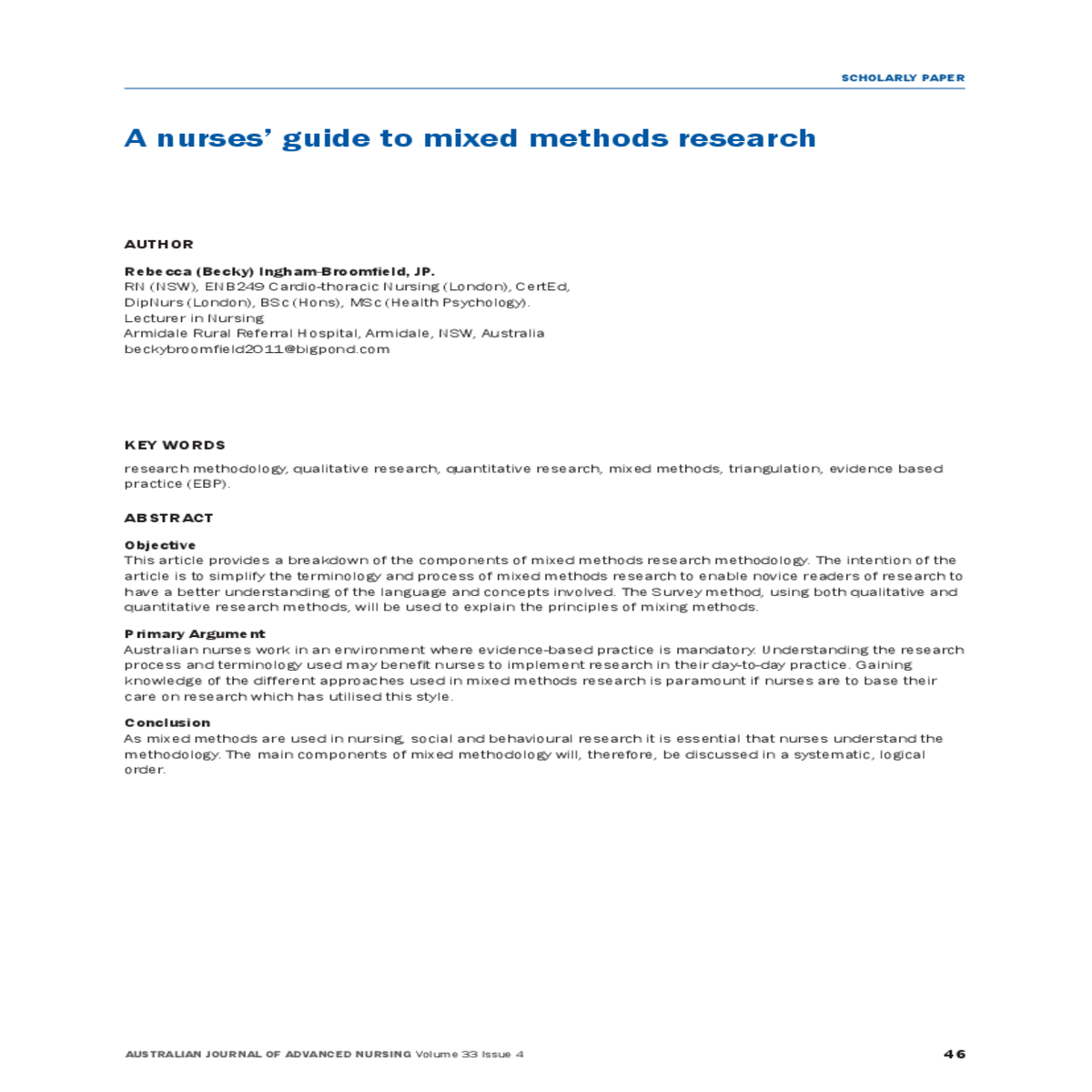
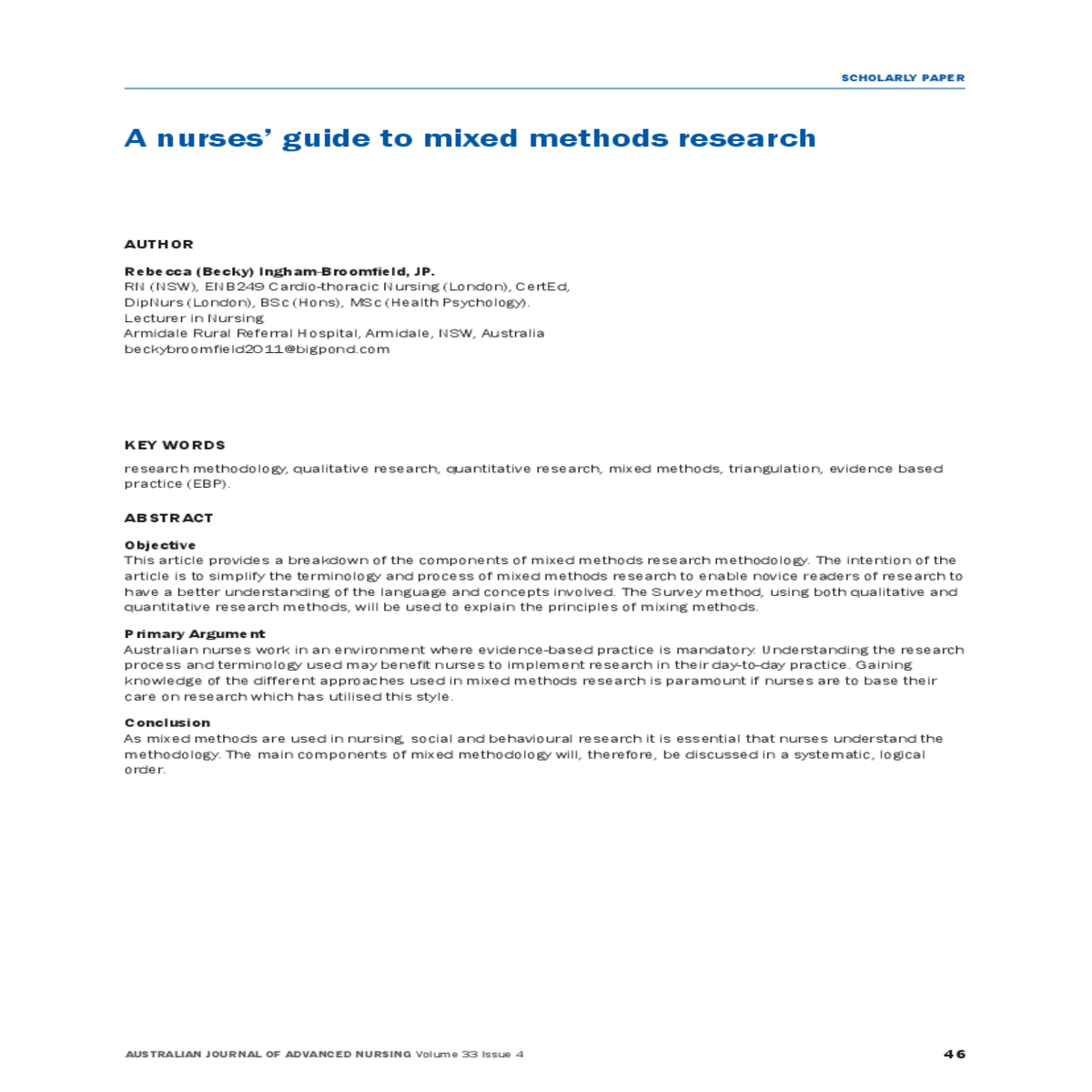
A nurses’ guide to mixed methods research
KEY WORDS
research methodology, qualitative research, quantitative research, mixed methods, triangulation, evidence based practice�(EBP).
AUSTRALIAN JOURNAL OF ADVANCED NURSING Volume 33 Issue 4 46
SCHOLARLY PAPER
The rationale behind using a mixed methods approach
Many authors and investigators have discussed the rationale behind combining qualitative and quantitative research methodology. The following discussion provides a breakdown of the main reasons for using mixed methods.Mixed methodology can answer a research question from a number of perspectives and ensures there are no, or�fewer,�‘gaps’�to�the�information�collected�(Bulsara�2015;�Jirojwong�et�al�2014).�Pre-existing�assumptions�from the researcher are less likely to occur, and inferences made stronger, as different approaches can yield broader information given that one method may not be able to provide all the information required (Bulsara�2015;�Jirojwong�et�al�2014).�As�Wurtz�(2015)�explains,�using�mixed�methods�can�provide�a�deeper�understanding�of�behaviour,�or�a�better�idea�of�the�meaning�behind�what�is�occurring.�Most�significantly�mixed�method research can include culture in the design by giving a voice to everyone involved in the behaviour being examined (Wurtz 2015). As Taket (2013) further explains, mixed methods can empower research participants by providing appropriate means for them to choose how and whether to participate. For example, a self‑completion questionnaire excludes those who do not have the ability to read or write (Taket 2013), however, if an interview is also included in the methodology, they may be able to participate with greater autonomy (Liamputtong 2013, p.326).
Survey Method
The Survey Method will be used as an example of how qualitative and quantitative frameworks can be used together�to�research�subjects.�A�survey�is�defined�as�a�data�collection�tool�to�gather�information�about�individuals (Privitera 2014). It may aim to collect factual information (quantitative data) and/or opinions of individuals through interviews (qualitative data). Surveys may be wholly quantitative but using mixed methods allows for greater depth. It is one of the most commonly used methods in social science research (Hamer and Collinson 2014).Abstract/Summary
An abstract or summary of a mixed methods paper using survey technique will provide a brief objective summary of the research report. The rationale and background of the study should be provided and also include�the�theoretical�and�methodological�processes�for�gathering�information�(Borbasi�and�Jackson�2012).�There are three types of questions or statements used in a survey, namely open‑ended items, partially open‑ended and restricted items (Privitera, 2014). The open‑ended questions can be used in interviews on an individual basis, or within a focus group, to glean qualitative information. A focus group is based on group discussion�to�elicit�the�respondent’s�perceptions,�opinions,�beliefs�and�attitudes�(Jirojwong�et�al�2014,�p.359).�The participants are able to express their views by interacting within a group discussing an issue or number of issues (Liamputtong 2013). Partially open questions have several set answers but allow the researcher to ask extra questions (Jirojwong et al 2014; Liamputtong 2013). An example of a restricted item, also known as a closed‑ended item, includes restricted answer options and commonly uses a Likert scale (Privitera 2014). The Likert scale usually has between three and seven columns with options such as strongly agree, agree, not sure, disagree and strongly disagree. Whilst the Likert scale can be used to elicit responses regarding attitudes and beliefs, statistics can be produced from the responses as the responses can be assigned a numerical value (Jirojwong et al 2014, p.360).
AUSTRALIAN JOURNAL OF ADVANCED NURSING Volume 33 Issue 4 48
Ethics
Consent�should�be�obtained�after�full�explanation�of�the�study’s�intent�(Borbasi�and�Jackson�2012).�All�nursing�research�should�consider�ethics�and�potential�harm�(Nursing�and�Midwifery�Board�of�Australia�2013b).�For�example, data collection from web surveys should be undertaken so identities cannot be accessed. Participants should�be�de-identified�(Liamputtong�2013,�p.30).�The�investigator�is�obliged�to�consider�the�implications�of�the�proposed�research�for�the�participating�subjects,�their�families�and�society�(Burns�and�Grove,�2009).�Permission for nursing research is sought from an ethics committee appropriate to the situation (Jirojwong et al�2014,�pp.63-66;�Elliott�et�al�2013,�p.93).�The�ethical�principles�of�autonomy,�beneficence,�non-maleficence�and justice are widely acknowledged in contemporary regulatory research ethics frameworks (Liamputtong 2013, p.27).Pilot Study
A pilot study as a trial run of the research which is conducted on a small number of participants (Polit and Hungler 2013; Nieswiadomy 2012). The pilot study allows the researcher to assess the adequacy and feasibility of the intended research (Moxham 2015, p.35). With mixed methods research, using a survey technique, is�important�to�identify�problems�or�‘flaws’�and�strengthen�the�combination�of�qualitative�and�quantitative�methodology�by�identifying�practical�and�methodological�issues�(Bulsara�2015).�Modifications�can�be�made�prior to the main study (Kim 2011).
Analysis and Results
Investigators may use codes or colour coding to identify common themes. The codes can be counted and totals�given�for�a�response�frequency�(Bulsara�2015).�This�works�well�with�survey�questions�and�responses�which�generate�figures�but�the�data�can�also�be�considered�qualitative�if�the�researcher�is�seeking�opinions�and�attitudes�(Bulsara�2015).�The�main�findings�will�be�discussed�according�to�which�design�was�used�(refer�to GRID below). Issues may arise when analysing the data because of the combination of the qualitative and quantitative designs. This may mean the researcher has to gather more data or revisit databases (National Institutes of Health 2011).Two�articles�in�this�series�discuss�this�section�in�more�depth,�namely,�A�nurses’�guide�to�Quantitative�research�(Ingham-Broomfield�2014)�and�A�nurses’�guide�to�Qualitative�research�(Ingham-Broomfield�2015).
The methodological approach used in this paper has discussed mixed methods, using the survey method as an example, in a logical and systematic order. This paper has discussed the main components of mixed methods research for nurses who are new to this process and its terminology.
AUSTRALIAN JOURNAL OF ADVANCED NURSING Volume 33 Issue 4 50
| Sequential | Sequential |
|
|
|||
|---|---|---|---|---|---|---|
| Explanatory | Exploratory |
|
Transformative | |||
|
||||||
|
||||||
|
QUAN�stage� | 2 distinct stages | QUAL�and�QUAN� | QUAL�and�QUAN� | ||
| and analysis | followed by |
|
|
|||
| QUAL�stage | perspective used | is concurrent – |
|
|||
|
to guide the study | |||||
| followed by | collection phase | QUAL�and�QUAN� | ||||
| collected during |
(Wurtz 2015; Lewis 2013)
REFERENCES
Benner,� P.� 1984.� Benner’s� Stages� of� Clinical� Competence� 13-34.� Retrieved� from� http://www.health.nsw.gov.au/nursing/projects/ Documents/novice‑expert‑benner.pdf (accessed April 2016).Elliott, D., Aitken, L. and Chaboyer, W. 2013. ACCCN’s Critical Care Nursing. Mosby Elsevier: Chatswood, Sydney.
Hamer,�S.�and�Collinson,�G.�2014.�Achieving�Evidence-Based�Practice�-�A�Handbook�for�PracticeRetrieved from http://bookdirectory. net/?p=312122 (accessed April 2016).
SCHOLARLY PAPER
Lewis, J. 2013. Mixed Methods Research. In S. Jirojwong, M. Johnson and A. Welch (ed), Research Methods in Nursing and Midwifery (1st ed). Oxford University Press: Sydney, Australia
Liamputtong, P. 2013. Research Methods in Health. Oxford University Press: South Melbourne, Australia
Moxham,�L.�2015.�Nurse�Education,�Research�and�Evidence-Based�Practice.�In�A.�Berman,�S.�J.�Snyder,�T.�Levett-Jones,�M.�Hales,�N.�Harvey,�Y.�Luxford,�L.�Moxham,�T.�Park,�B.�Parker,�K.�Reid-Searl�and�D.�Stanley�(ed).�Kozier & Erb’s Fundamentals of Nursing (3rd ed, Vol. 1). Pearson Australia: Frenchs Forest, Sydney.Polit,�D.F.�and�Hungler,�B.P.�2013.�Essentials of Nursing Research: Methods, Appraisal, and Utilization (8th Edition ed). Wolters Kluwer/ Lippincott Williams & Wilkins: Philadelphia.
Privitera, G.J. 2014. Research Methods for the Behavioural Sciences. SAGE publications: London.