Derive the transfer function the following differential equation the form
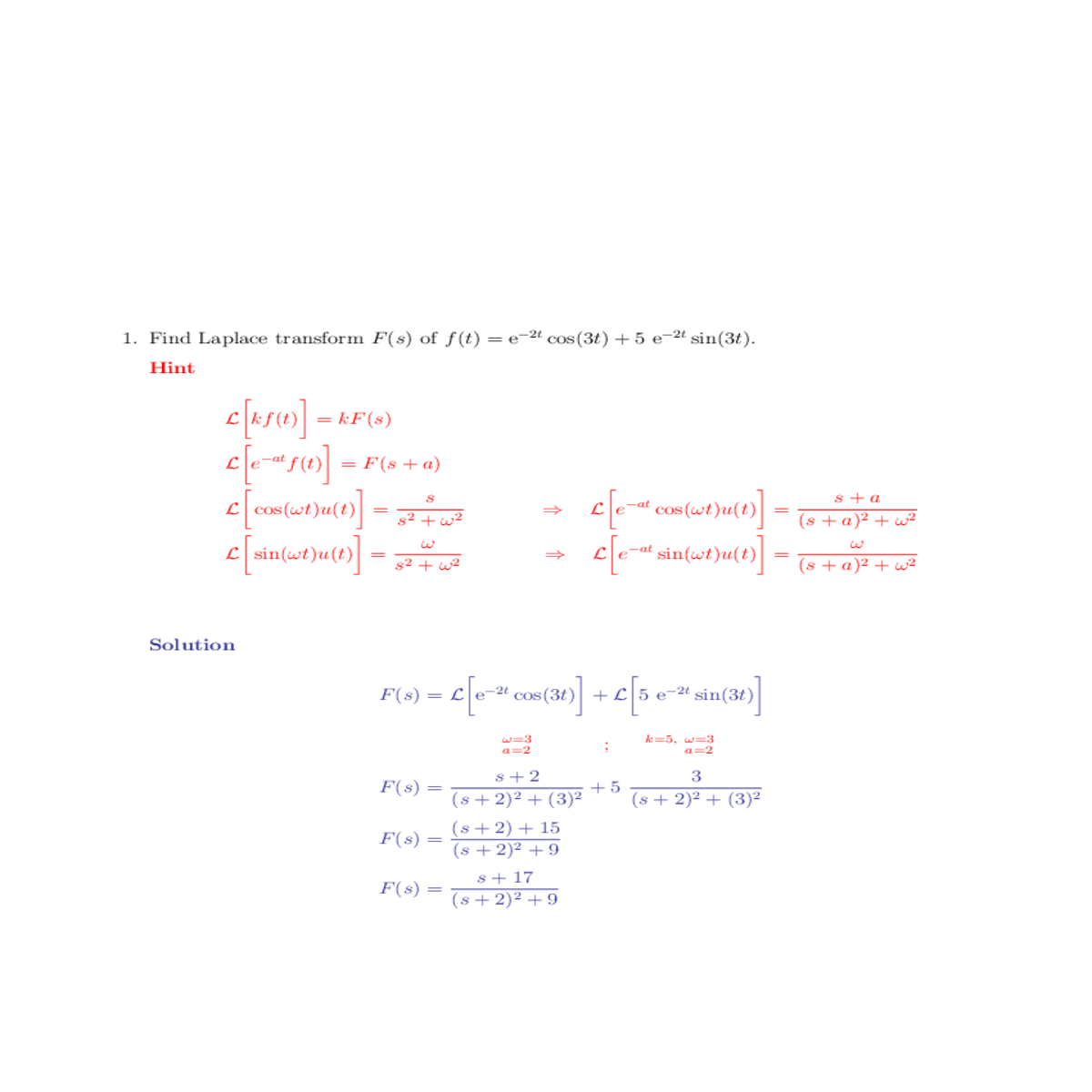
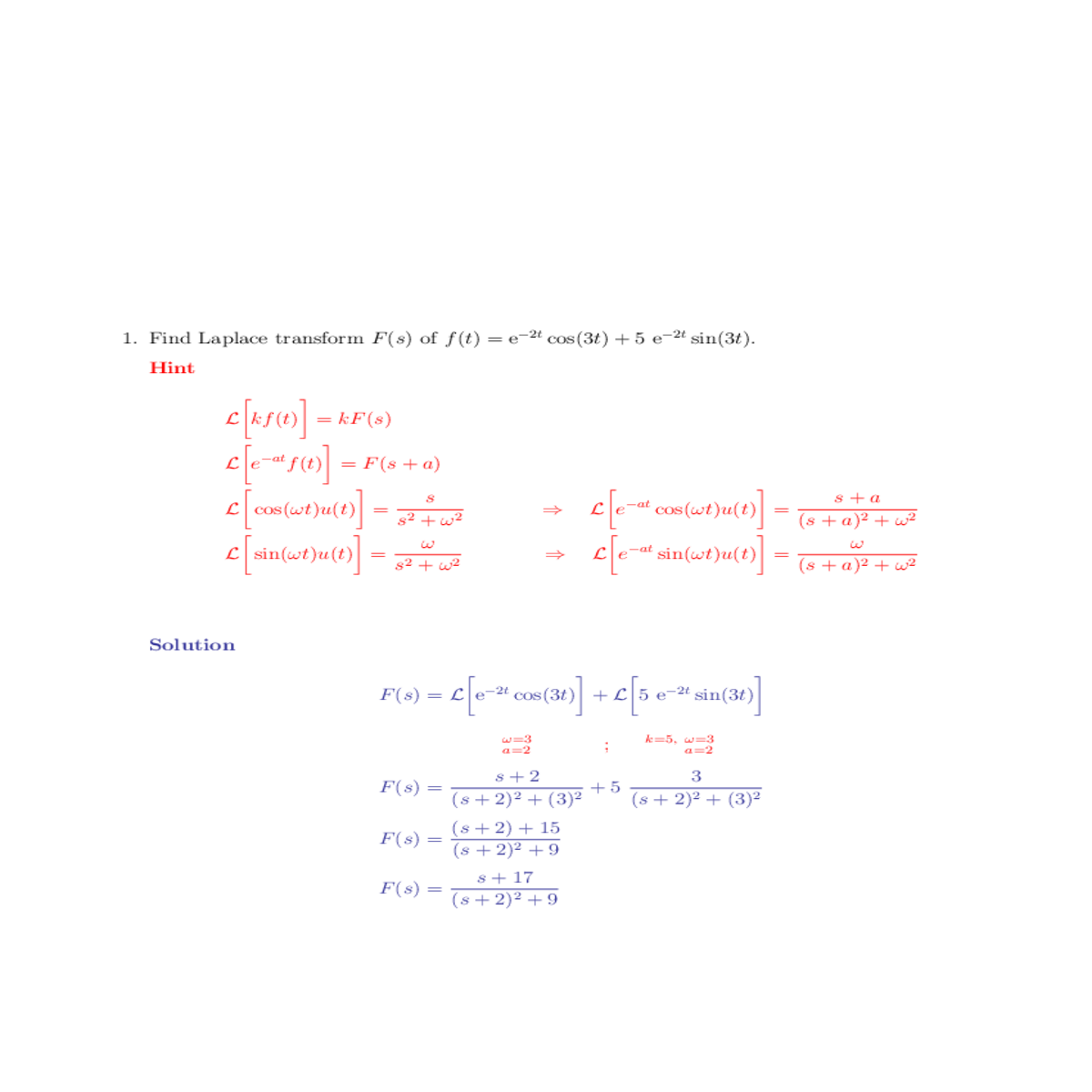
1. Find Laplace transform F(s) of f(t) = e−2tcos(3t) + 5 e−2tsin(3t).
Hint
| F(s) = L�e−2tcos(3t)� | + L� | |||
|---|---|---|---|---|
| ω=3 | ; |
|
||
| a=2 |
|
|||
| F(s) = | 3 | |||
| F(s) = L�10� | + 5L�t� | + L�t2 | � | − 4L�t3 | |||
|---|---|---|---|---|---|---|---|
| n=1 | n=2 | ; | n=3 | ||||
|
|
||||||
F(s) = 10s3 + 5s2 + 2s − 24 s4 |
|||||||
| F(s) = 2L� | e3t | � | + 4L | �t e3t | � | + L�t2e3t | � | |||
|---|---|---|---|---|---|---|---|---|---|---|
| a=−3 | n=1 | ; | n=2 | |||||||
|
a=−3 | |||||||||
(s − 3)3 |
2 | |||||||||
| (s − 3)3 | ||||||||||
4. Find Laplace transform F(s) of f(t) = 6 e5tcos(2t) − e7t.
Hint
4
6. Apply partial fraction expansion to the expression:
| 4s + 7 | |
|---|---|
| F(s) = | (s + 1)(s2+ 5s + 16) |
(s + 1)(s2+ 5s
+ 16)= A(s2 + 5s + 16) + (Bs + C)(s + 1)
4s + 7 = A(s2+ 5s + 16) + (Bs + C)(s + 1) (1)• Apply lims→−1 to find A:
4 × −1 + 7 = A((−1)2+ 5 × (−1) + 16) + 0 A = 1
4
| 4s + 7 = | � 1 4+ B | � | s2+ | � 5 4+ B + C | � |
|
||||
|---|---|---|---|---|---|---|---|---|---|---|
| 7 = 4 + C | ∴ |
|
||||||||
| ∴ | ||||||||||
| F(s) = | 1 | |||||||||
|
||||||||||
5
Solution
• Take the Laplace transform of the both sides and find Y (s)
| sY (s) − y(0) = 3 1 s− 2 1 s2 |
|---|
|
|
(1) |
|---|---|---|
| 3s − 2 = As2+ Bs + C | ||
In order to find A, we differentiate both sides of equation (2):
| Y (s) = 3 s2 − 2 s3. | (3) |
|---|
7