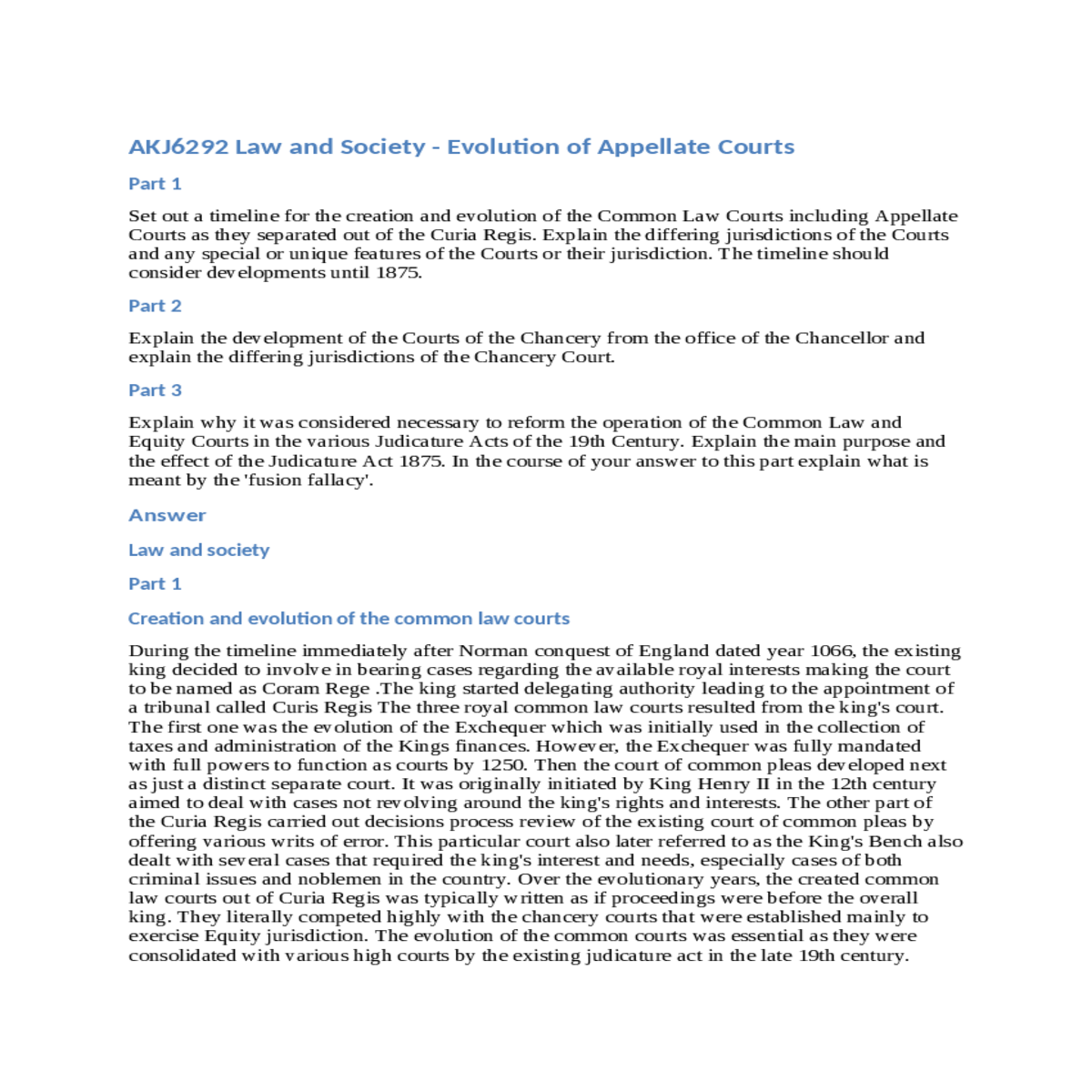
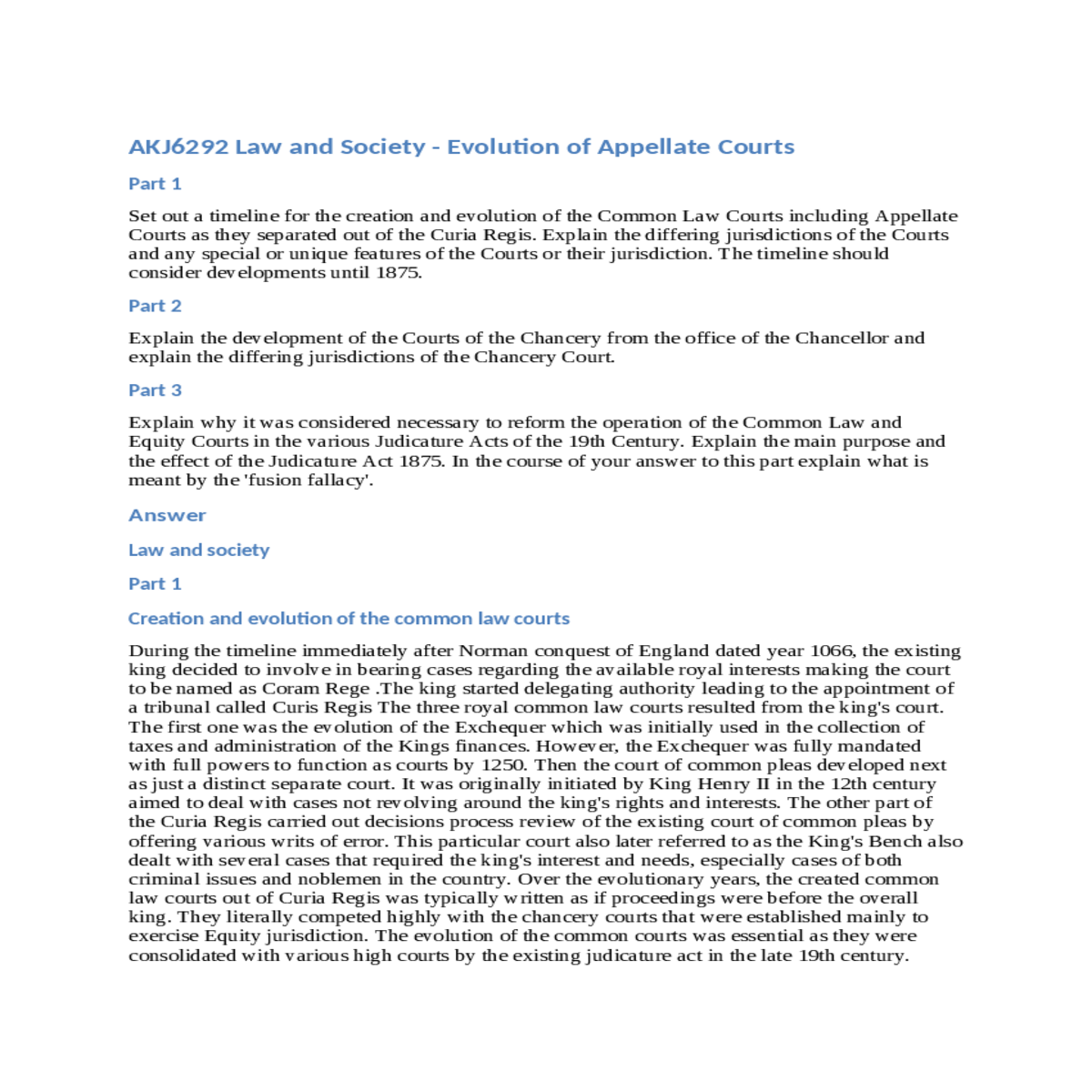
Creation and evolution of the common law courts
AKJ6292 Law and Society - Evolution of Appellate Courts
Part 1
Set out a timeline for the creation and evolution of the Common Law Courts including Appellate Courts as they separated out of the Curia Regis. Explain the differing jurisdictions of the Courts and any special or unique features of the Courts or their jurisdiction. The timeline should consider developments until 1875.
Part 2
Explain the development of the Courts of the Chancery from the office of the Chancellor and explain the differing jurisdictions of the Chancery Court.
Part 3
Answer
Law and society
Part 1
Creation and evolution of the common law courts
Timeline
Year |
Development |
Norman conquest Evolution of Exchequer |
|
| 1178 | The common court of pleas |
| 1258 | The parliament used a court in hearing cases |
| 1273 | Assize circuit courts |
| 1300 | The chancery courts evolved |
| 1500 | The interested parties in a court of appellate got disqualified |
| 1600 | Nonparties disqualified |
1870 1875 |
Evolution of appellate courts
Jurisdictions
Some jurisdictions acquire specialized appellate courts such as Australian federal appellate courts that hear appeals from criminal cases. Conversely, the courts' judgment gives the final directive of the common law courts as to the case appealed, clearly setting out and specifying its continued determination that the matter appealed from ought to undergo modification, affirmation, remand and high reversal ability. Depending on the system, various common law courts may operate both as trial courts and appellate courts, dealing with appeals of decisions finalized by lower courts having quite limited jurisdictions. They have general jurisdiction but generates most caseload from patent cases.
In the U.S the state and federal appellate courts are restricted to establishing if the lower court carried out the correction required legal determinations and not listening to direct evidence and examining whether the facts of the case were true. The appellate courts are restricted to dealing with appeal case based on the matter that was initiated before the court of trial. Some appellate courts like supreme have consisted of a power of discretionary review. Evidently, only a little portion of trial courts decisions outcomes appears on common law courts including the appellate courts.
Part 2
Developments of the courts of chancery from the office of the chancellor
Evidently, the Court of chancery started to develop as from the fifteenth century in order to give various remedies that could not be obtained in the courts. Courts of Chancery also referred to as courts of equity are operated as distinct jurisdictions in specific areas of the commonwealth. During the 15th century, As a result of dissatisfactions involving powerful local lords who engaged in either bribing or intimidation of juries and court order defiance, the available litigants consequently petitioned their cases to the councils in order to call out for justice. These petitions of the disappointed people were called the Lord Chancellor. The Lord Chancellor designed upset of equitable remedies enacted remedies for their operatory activities. In exercising the jurisdiction, the main chancellor was never strictly bound or held by precedent. A chancellor could not agree to deal with a case that had limited remedy like damages.
The court of chancery was established as at 16th century meant to be the dispenser of equity.
Jurisdiction of the court of chancery
Part 3
Why were the reforms of the courts necessary?
Among the reforms to a procedure that occurred due to the enactment of the judicature act was necessary since it led to the impacting on the matter of abandonment action. This ensures discontinuance of various case proceedings carried out in the high court. The reform on Order xxx rule known as the summons for directions. It was necessary to make respective pleadings and several proceedings. Another change carried out by the rules called revolutionary reform made it possible for every matter of fact in a common law for example damage to be extensively decided by the main verdict of the jury.
Purpose
The judicature had two main purpose;
- To ensure amalgamation of the procedures and process involving the old common law and equitable jurisdictions by carrying out abolishment of the existing common law system. This is done to enhance one tribunal that would properly administer law and equity jurisdictions.
- To enable the establishment of equity power over the common law in a situation of a certain conflict between two jurisdictions.
Fusion fallacy
Bibliography
Imber, Michael, and Tyll Van Geel. Education law . Routledge (Federation Press, 1st, 2010).
Klinck, Dennis R. Conscience, Equity and the Court of Chancery in Early Modern England. Routledge (Federation Press, 15th ed, 2016).
Quillen, William T., and Michael Hanrahan. "A Short History of the Delaware Court of Chancery--1792-1992." Del. J. Corp. L.18 (1993): 819 (Federation Press, 9th ed, 2013).
Rehnquist, William H. "The Prominence of the Delaware Court of Chancery in the State-Federal Joint Venture of Providing Justice." Bus. Law. 48 (1992): 351 (LexisNexis, 10th ed, 2016).