

Could infer invariant for that location
Invariant Detection

#1
|
#2 |
|---|
Motivation
#3
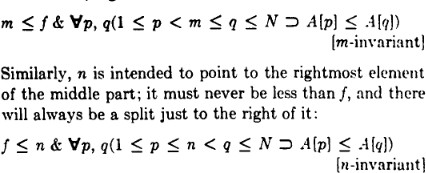
Finding Invariants Manually
• Some intermediate invariants:
“Reading Quiz”
• What is “FIND” all about?
| Cunning Plan |
|---|

• Given a program location, if we could infer an invariant for that location, we could have … – Loop invariants (location = loop head)
– Function pre-conditions (location = entry)
– Function post-conditions (location = exit)
• Can we do this automatically?
– An indicative workload
– High-coverage test cases
• Given:
– while b do c
• Instrument:
– while b do (print Inv1; print Inv2; … ; c)
– Run on all tests, filter out on false
• How many candidate invariants are there?

|
|---|
• At most three variables at a time: finite!
#11
| Daikon |  |
|---|---|
#12
Daikon Weaknesses• What could go wrong?
|
|---|

• Nothing prevents Daikon from finding these• But each increase in the language of
candidate invariants bloats the runtime
• False Positives from linguistic coincidence– Ex: ptr % 4 == 0
– Ex: x <= MAX_INT
– Not false, but not related to correctness.
#15
induce invariants via constraint solving
– Ex: instead of printing x>y, x<y, x>=y, etc., just print out x and y and figure out which is true later
| Dig |  |
|---|
Dig Example: Cohen's Division // quotient
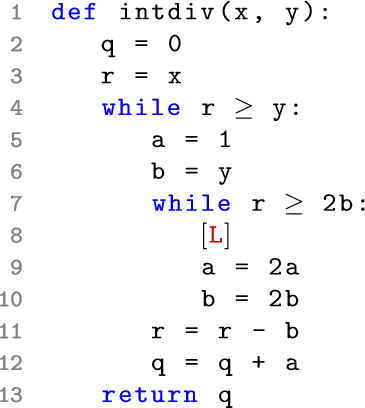
// remainder
// loop invariant
|
|
|---|