PART A
A1
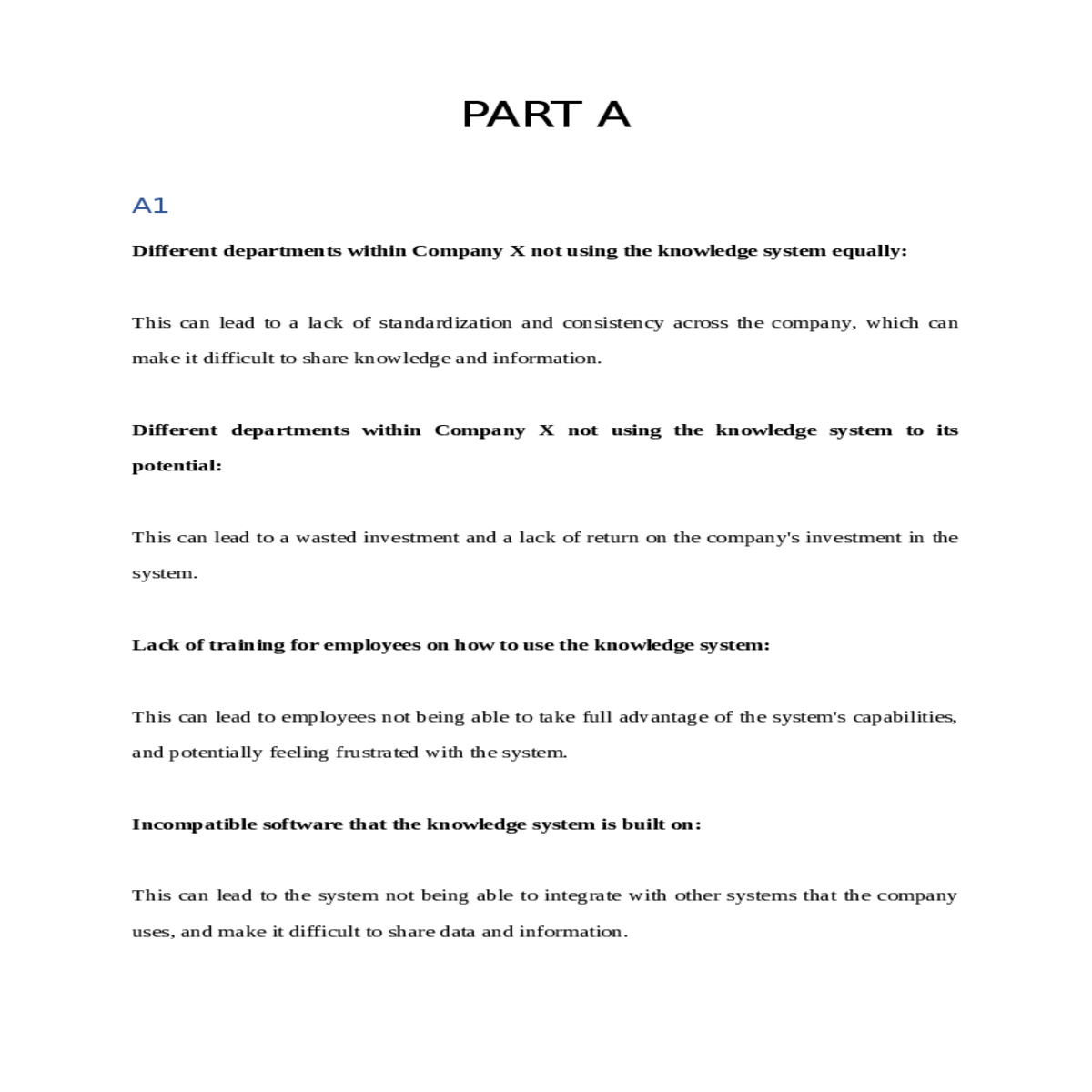
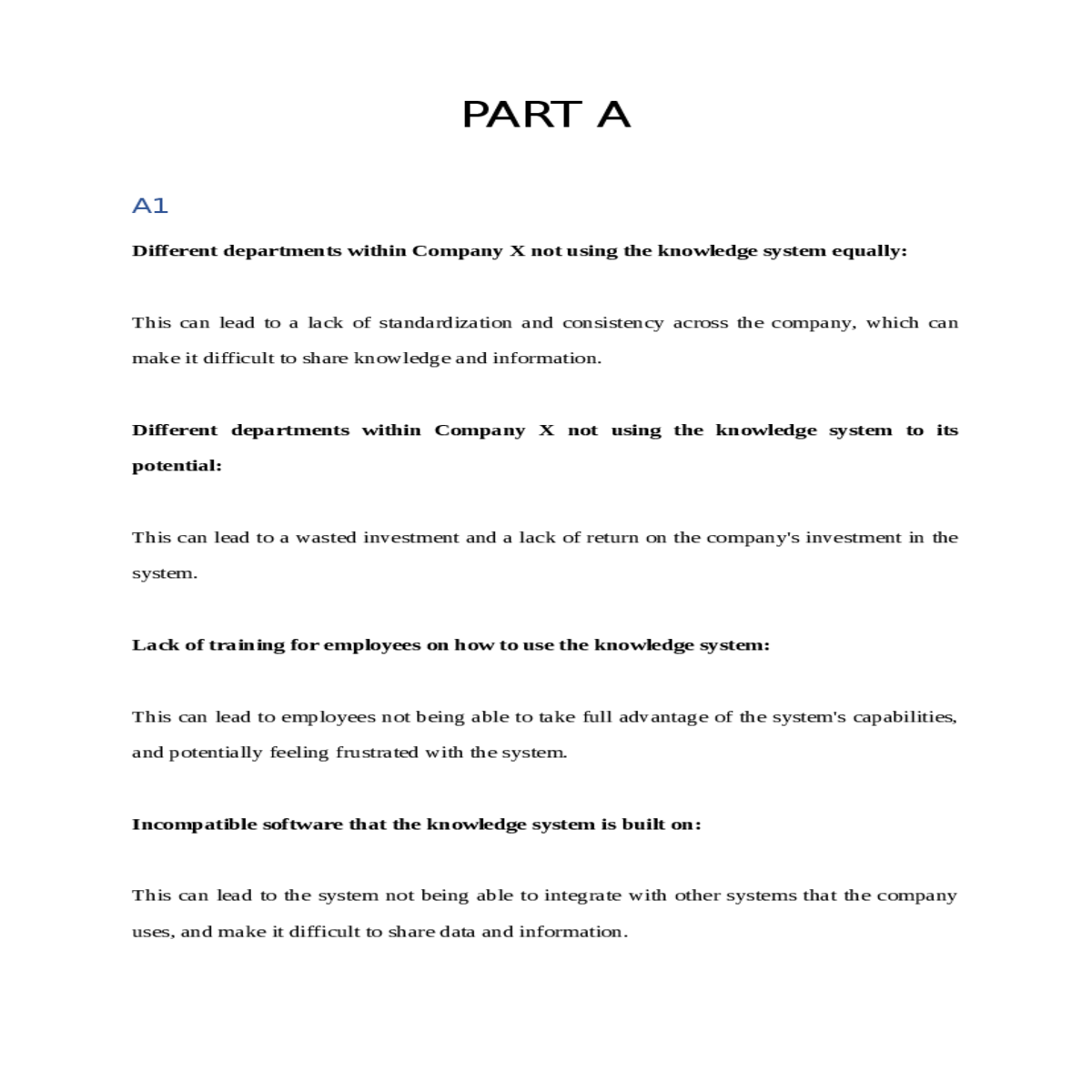
Different departments within Company X not using the knowledge system equally:
This can lead to a lack of standardization and consistency across the company, which can make it difficult to share knowledge and information.
Incompatible software that the knowledge system is built on:
This can lead to the system not being able to integrate with other systems that the company uses, and make it difficult to share data and information.
A2
A)
1. Education: The candidate should have a degree in computer science, engineering, or a related field.
2. Technical skills: The candidate should have strong technical skills, including experience with project management software and databases.
| PARAMETERS | WEIGHTS |
|---|---|
| Education: The candidate should have a degree in computer science, engineering, or a related field. | 20% |
| Technical skills: The candidate should have strong technical skills, including experience with project management software and databases. | 25% |
| Communication skills: The candidate should be able to effectively communicate with stakeholders, team members, and senior management. | 20% |
| Organizational skills: The candidate should be able to effectively organize and manage projects. | 20% |
| Experience: The candidate should have significant experience managing IT projects. | 15% |
Based on the above matrix the highest weighted score is of candidate B, therefore he is selected.
B)
A company might use a weighted scoring model to select a project manager, but there are other approaches that could be used as well. Some companies might choose to interview multiple candidates and then select the one they feel is the best fit for the position. Others might choose to promote someone from within the company who has already demonstrated their ability to lead and manage projects successfully.
A3
Another key difference is that the Agile approach relies on the expertise of the team members, while the traditional approach relies more on the expertise of the project manager. In the Agile approach, team members are encouraged to take ownership of their work and to make decisions based on their expertise and experience. This allows for more flexibility and creativity, and ultimately results in a better product.
The Agile approach also puts a strong emphasis on collaboration and communication. In traditional project management, there is often a clear separation between the different team members, with each member working on their own part of the project. This can lead to problems when it comes to integrating the different parts of the project. In contrast, the Agile approach encourages team members to work closely together from the start, which leads to a better understanding of the project as a whole and makes it easier to identify and solve problems (Ciric et al., 2019).
B1
At lower levels of project management, a more hands-on approach may be necessary in order to ensure that tasks are being completed according to plan. In this case, a more authoritarian or dictatorial leadership style would be more effective(Lategan and Fore, 2015). This type of leader would be able to provide clear instructions and ensure that team members are held accountable for their work. Transactional leaders are focused on results and ensuring that team members are held accountable for their work. They may be more likely to use rewards and punishments as motivation, rather than trying to inspire team members.
B2
The communication management plan for the Sydney Metro project should include the following:
5. An issues and crisis management plan that outlines how the project team will manage and respond to any issues or crises that may arise during the project.
6. An evaluation and review process that will be used to regularly review and assess the effectiveness of the communication management plan.
In general, it is important to carefully consider the procurement process in any large infrastructure project. There are a number of potential risks and challenges associated with contracting, and it is important to put in place adequate safeguards to protect the interests of all involved. The Sydney Metro project is a large and complex infrastructure project. The NSW Government has a strong commitment to ensuring the project is delivered on time and on budget. In order to achieve this, the NSW Government has established a Project Management Office within Transport for NSW to manage the procurement process for the project(Wysocki and Gillingham, 2012). The Project Management Office is responsible for developing the procurement strategy for the project, as well as overseeing the procurement process and ensuring that it is conducted in a fair, transparent and efficient manner. In order to ensure that the project is delivered on time and on budget, it is important that the procurement process is managed effectively (Wysocki and Gillingham, 2012).
There are a few key things to bear in mind when it comes to procurement and contracting in relation to the Sydney Metro project:
Have a clear understanding of the procurement process and the timeline for the project to ensure that you are able to select the right contractor in a timely manner.
References
Ciric, D., Lalic, B., Gracanin, D., Tasic, N., Delic, M., & Medic, N. (2019). Agile vs. Traditional Approach in Project Management: Strategies, Challenges and Reasons to Introduce Agile. Procedia Manufacturing, 39, 1407-1414. https://doi.org/10.1016/j.promfg.2020.01.314