Choose appropriate data types and constraints

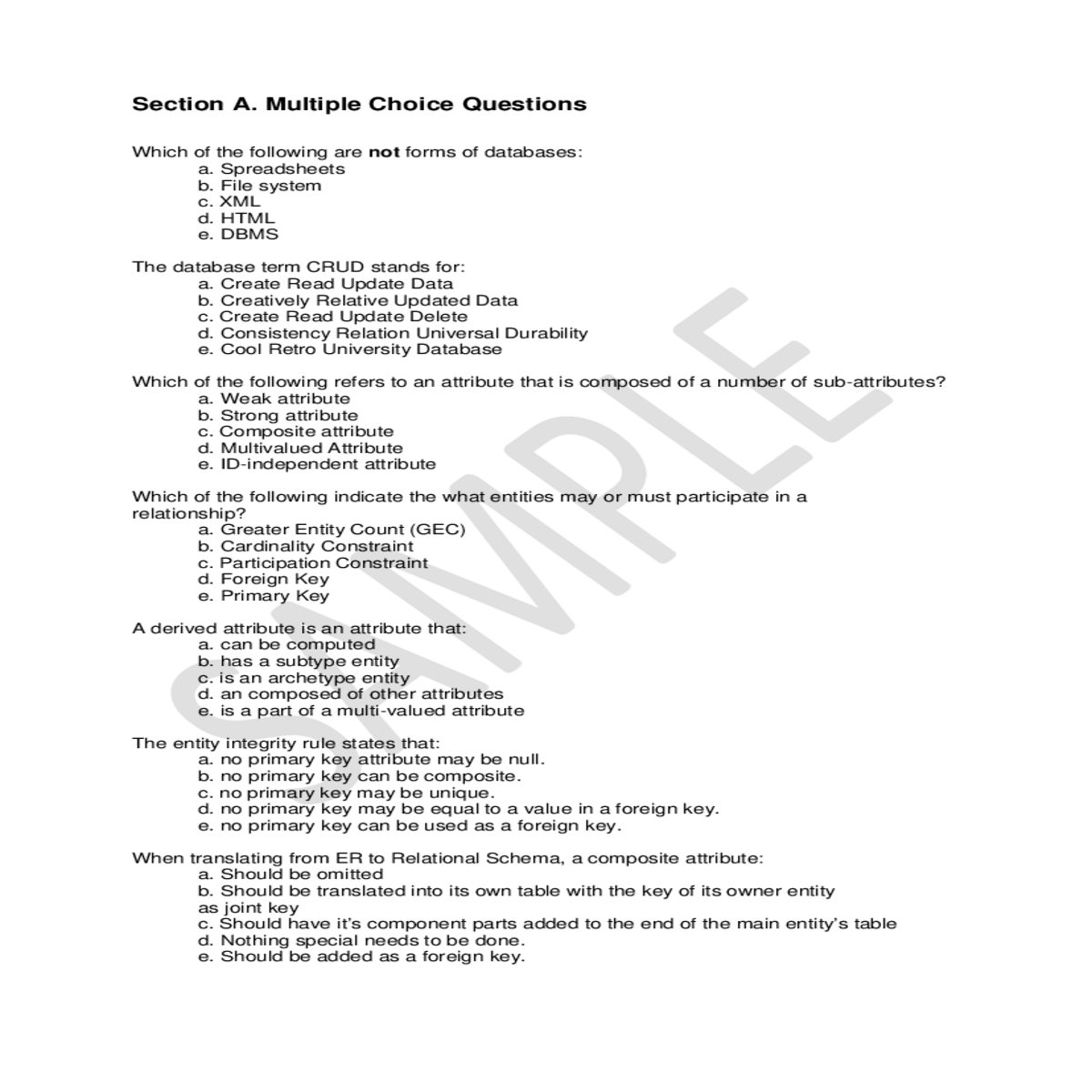
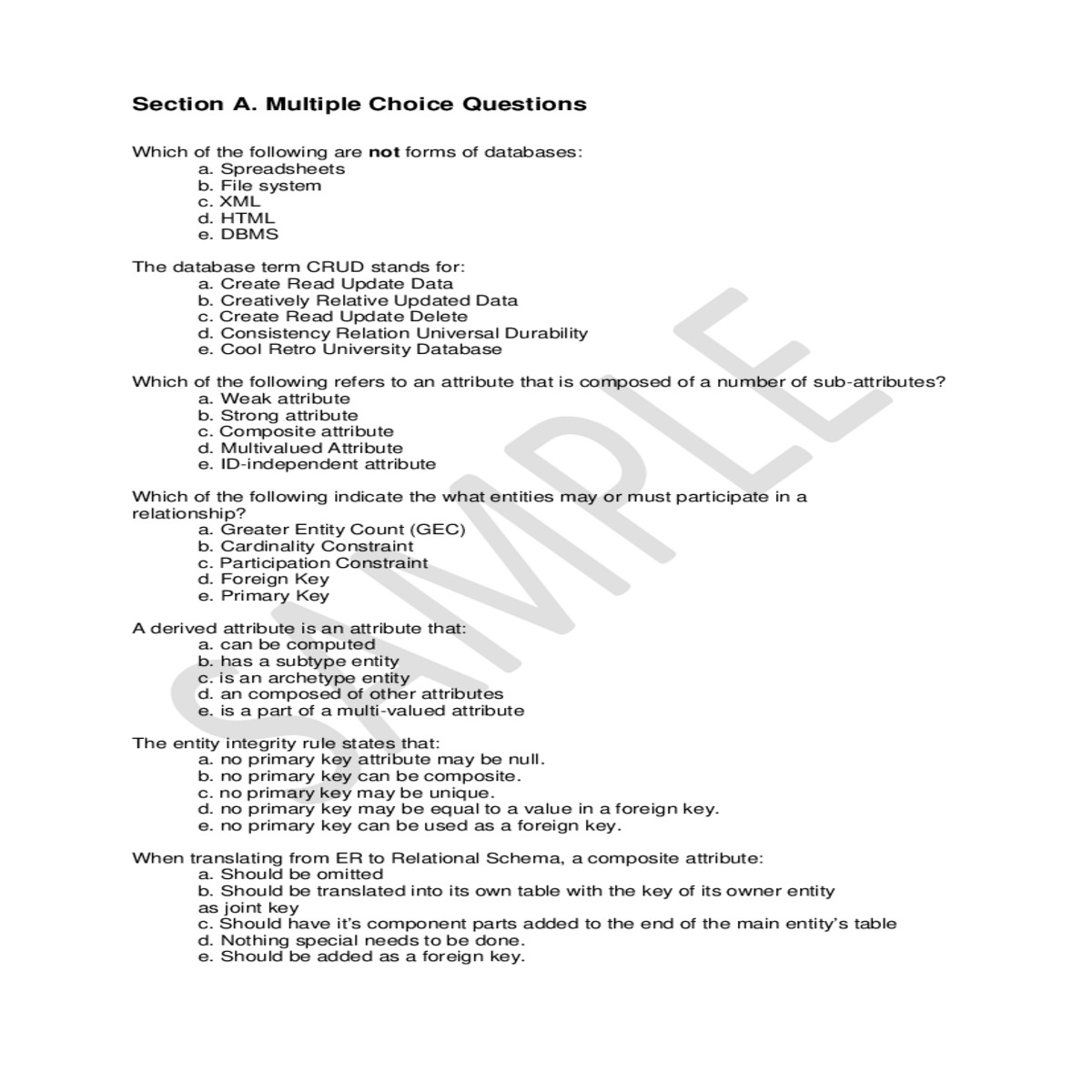
Section A. Multiple Choice Questions
Which of the following indicate the what entities may or must participate in a relationship?
a. Greater Entity Count (GEC)
b. Cardinality Constraint
c. Participation Constraint
d. Foreign Key
e. Primary Key
d. no primary key may be equal to a value in a foreign key. e. no primary key can be used as a foreign key.
When translating from ER to Relational Schema, a composite
attribute:
a. Should be omitted
b. Should be translated into its own table with the key of its owner
entity as joint key
c. Should have it’s component parts added to the end of the main
entity’s table d. Nothing special needs to be done.
Which of the following is not a type of SQL
constraint? a. Primary key
b. Not null
c. Foreign key
d. Super key
e. Unique
If the values in one or more attributes must exist in a set of
attributes in another table, we have created a:
a. Transitive Dependency
b. Composite Attribute
c. Foreign Key
d. Primary Key
e. Insertion Anomaly
WHERE PC.Title = 'Dr');
a. Nested-Correlated Subquery
b. Nested-Noncorrelated Subquery
c. Non-nested Subquery
d. Non-nested Correlated Subquery
e. None of the above.
Which of the following statements is a true statement concerning the open database connectivity standard (ODBC)?
a. Provides a programming interface that provides a common language for application programs to access and process SQL databases independent of the RDBMS accessed.
a. Table
b. Column
c. Key
d. Primary Key
e. Foreign Key
Section B overleaf
Figure 1 - Paws Pet Hotel Spreadsheet sample
Figure 2- Relational Schema for Paws Pet Hotel Database
Recreate the Figure 2 Relational Schema into a 3rd Normal Form Relational Schema (10 Marks)
Question 23.
Create the INSERT SQL scrip for all of your tables based on the sample spreadsheet data (10 Marks)
Question 26.
d) Paws Pet Hotel manager want a list of all animals and their owner names with a ‘o’ (upper and lower case) in their animal name (5 Marks).