Cepheid Variable: Luminosity and Flux Answers needed
Your question:
Stars and Elementary Astrophysics I (week 3)
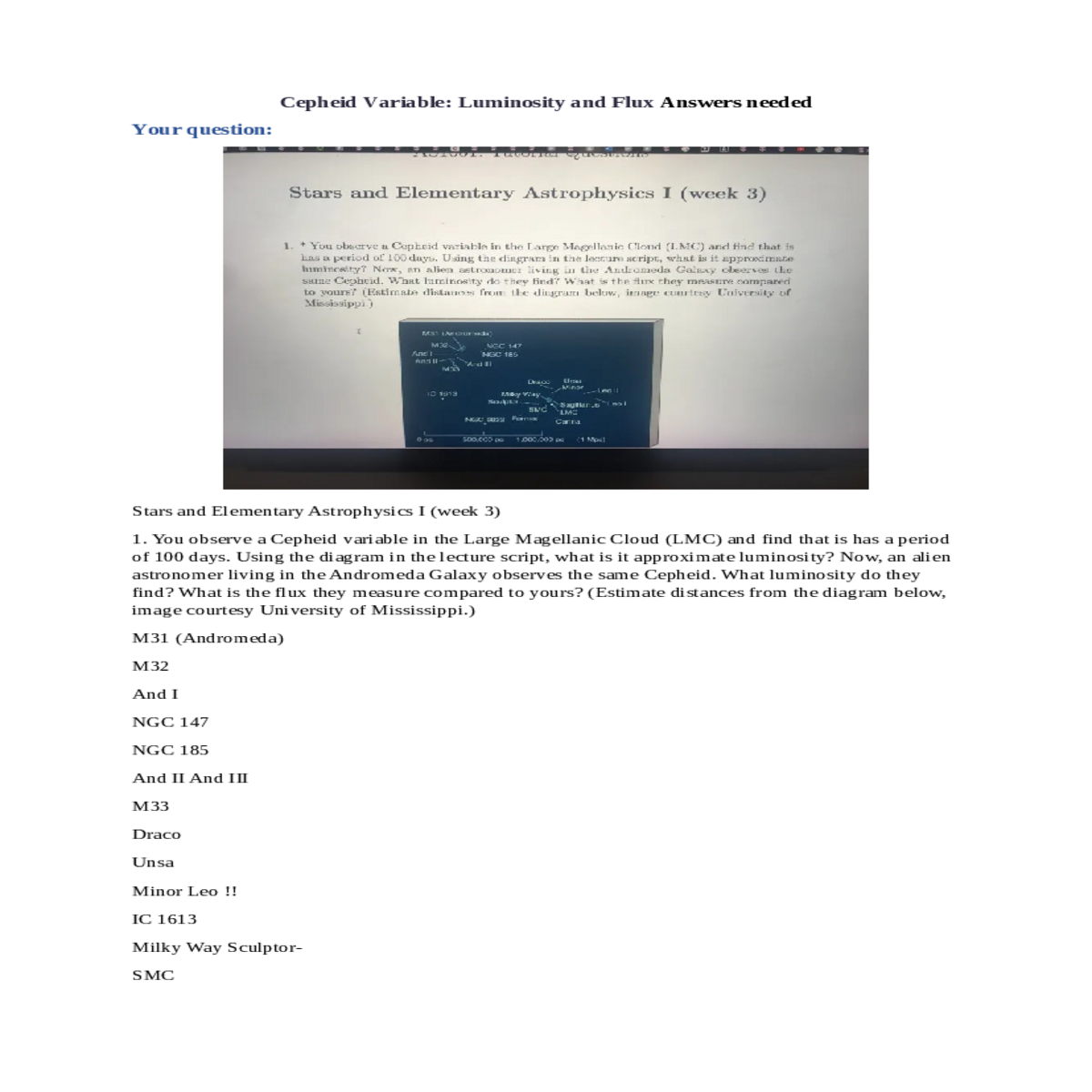
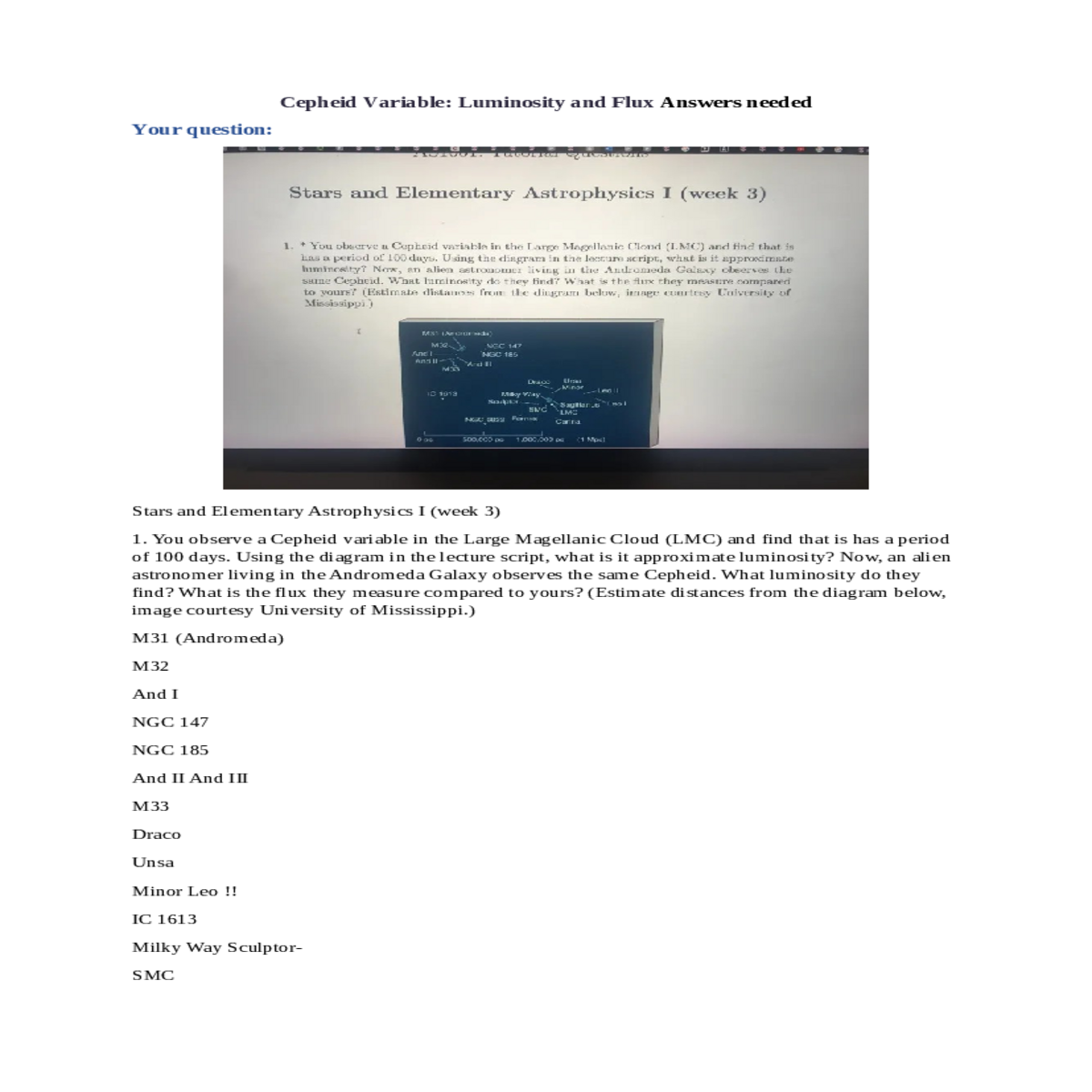
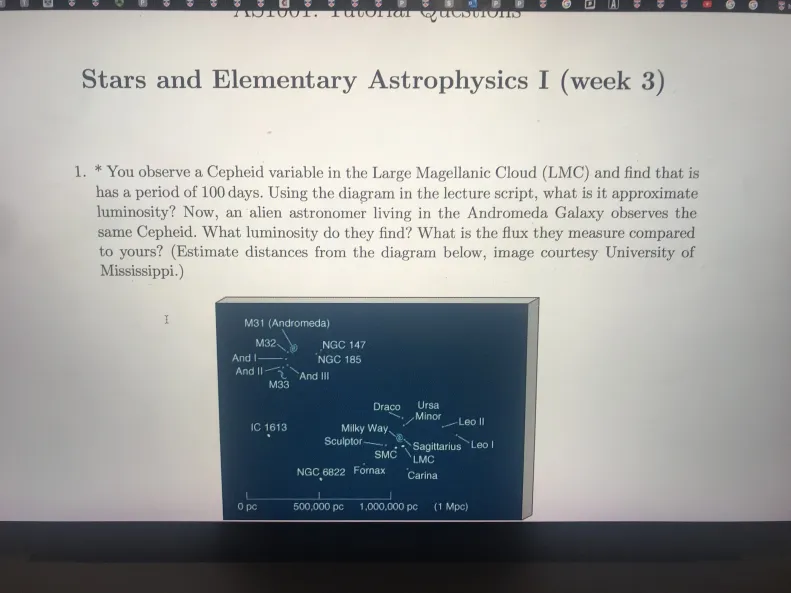
1. You observe a Cepheid variable in the Large Magellanic Cloud (LMC) and find that is has a period of 100 days. Using the diagram in the lecture script, what is it approximate luminosity? Now, an alien astronomer living in the Andromeda Galaxy observes the same Cepheid. What luminosity do they find? What is the flux they measure compared to yours? (Estimate distances from the diagram below, image courtesy University of Mississippi.)
NGC 185
And II And III
IC 1613
Milky Way Sculptor-
Carina
0 pc
Cepheid Variable: Luminosity and Flux Answers and Explanation:
Step-by-step explanation of the Cepheid variable's luminosity and observed flux:
Period-Luminosity Relation: We know the Cepheid has a period of 100 days. From the diagram in the lecture script (which should show a period-luminosity relation for Cepheids), you can find the corresponding approximate luminosity, let's say L.
Distance Correction: However, this luminosity is the Cepheid's intrinsic luminosity, not what you directly observe. To get the observed luminosity (L_obs), we need to account for the distance to the LMC. From the provided image, estimate the distance from the Milky Way to the LMC as d_LMC. Use the inverse-square law of light: L_obs = (L) / (4π * d_LMC^2)
Flux and Luminosity: Flux is the amount of energy passing through a given area per unit time. It relates to luminosity through the distance squared: Flux = L / (4π * distance^2)
Comparing Fluxes: To compare your observed flux (Flux_you) to the alien's (Flux_alien), simply use the above relationship and the different distances you estimated: Flux_you / Flux_alien = (d_Andromeda_LMC^2) / (d_LMC^2)