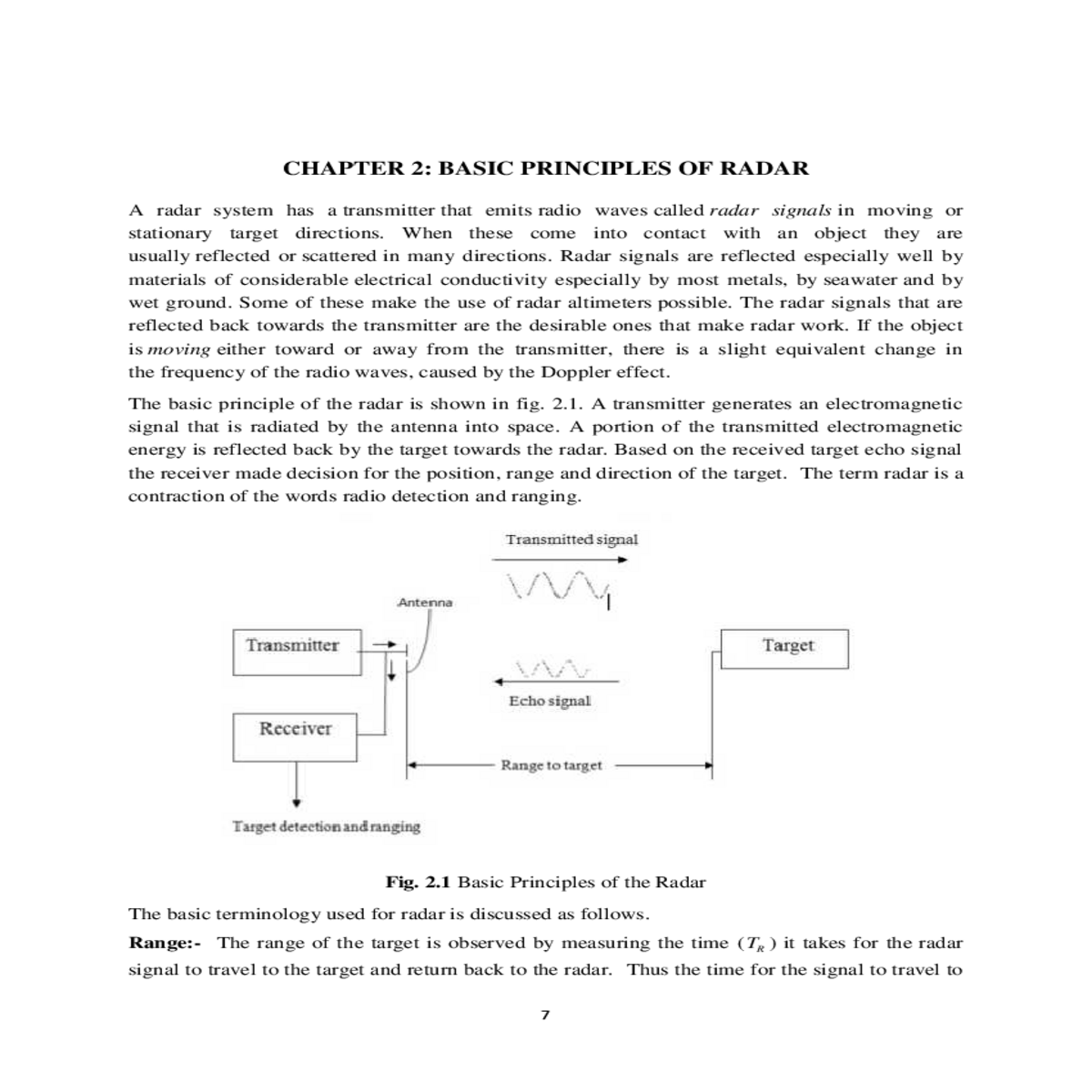
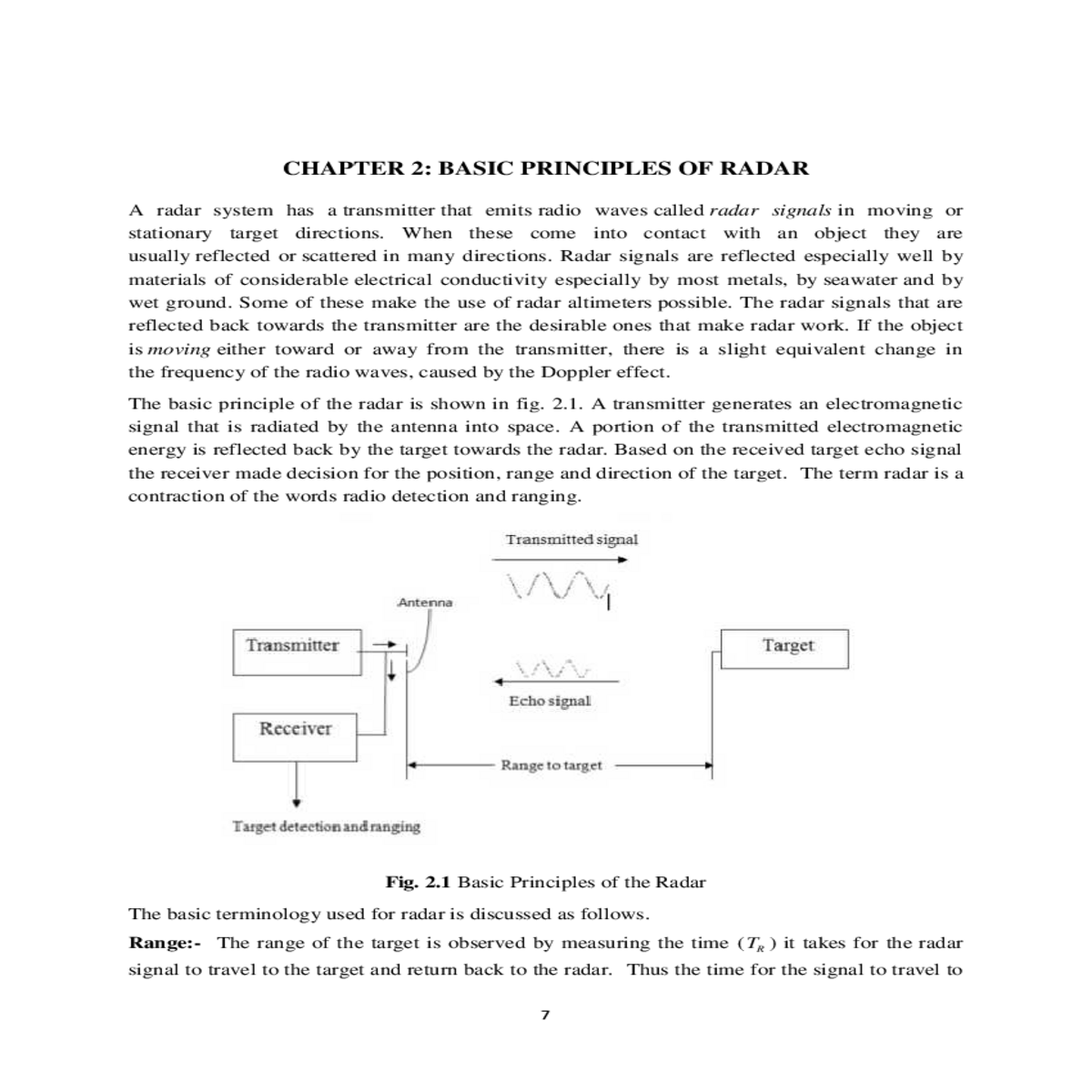
Caused the doppler effect basic principle the radar shown fig
CHAPTER 2: BASIC PRINCIPLES OF RADAR
A radar system has a transmitter that emits radio waves called radar signals in moving or stationary target directions. When these come into contact with an object they are usually reflected or scattered in many directions. Radar signals are reflected especially well by materials of considerable electrical conductivity especially by most metals, by seawater and by wet ground. Some of these make the use of radar altimeters possible. The radar signals that are reflected back towards the transmitter are the desirable ones that make radar work. If the object is moving either toward or away from the transmitter, there is a slight equivalent change in the frequency of the radio waves, caused by the Doppler effect.
Range:- The range of the target is observed by measuring the time ( T ) it takes for the radar R
signal to travel to the target and return back to the radar. Thus the time for the signal to travel to
| … (1) |
|---|
| R km ) | = | 0.15 | T R | ( | | s | ) | s |
|
… (2) | ||
|---|---|---|---|---|---|---|---|---|---|---|---|---|
| R nmi | ) | = | 0.081 T R | ( | | |||||||
Maximum Unambiguous Range:- Once a signal is radiated into space by a radar, enough time must elapse to allow all echo signal to return to the radar before the transmission of next pulse. The rate at which the pulses are transmitted, is determined by the longest range of the target. If the time between pulses T is too short, an echo signal from the long range target might arrive P
| calculation, if it is not known that this is second time echo. The range beyond which the target | ||||||||||||
|---|---|---|---|---|---|---|---|---|---|---|---|---|
| appears as second-time-around-echoes is the maximum unambiguous range, | ||||||||||||
| R un | = | cT P | = | c | ||||||||
| 2 | 2 | f | ||||||||||
| f | = | 1 | … (3) | |||||||||
| p | T P | |||||||||||
| Dutycycle | = | |||||||||||
| T P | ||||||||||||
| Where | T is the pulse repletion time and P |
|
||||||||||
A problem with pulsed radars and range measurement is how to unambiguously determine the range to the target if the target returns a strong echo. This problem arises because of the fact that pulsed radars typically transmit a sequence of pulses. The radar receiver measures the time between the leading edges of the last transmitting pulse and the echo pulse. It is possible that an echo will be received from a long range target after the transmission of a second transmitting pulse.