Can use the nernst equation
Solved Step by Step With Explanation- Change in Electrode Potential
Questions
Answer
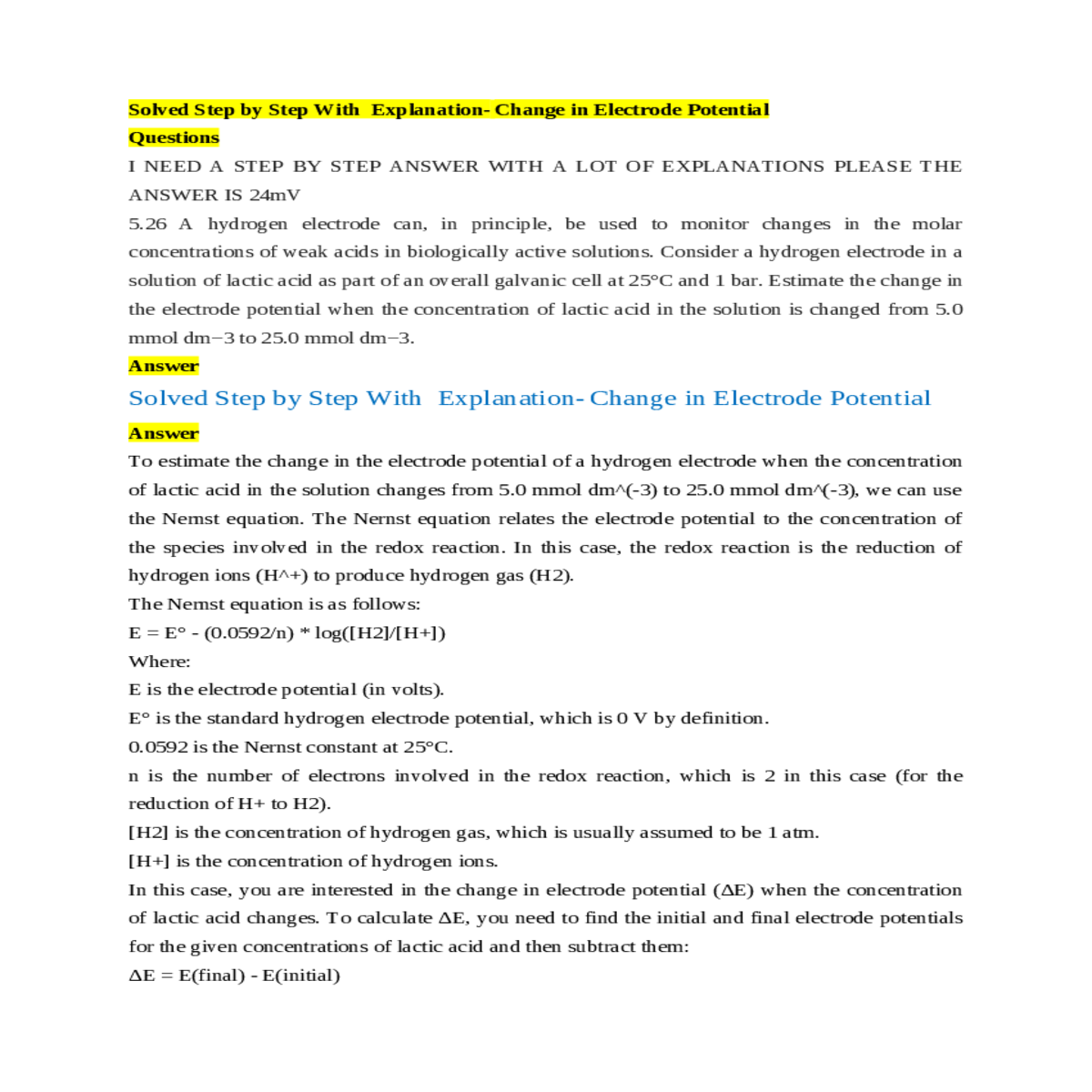
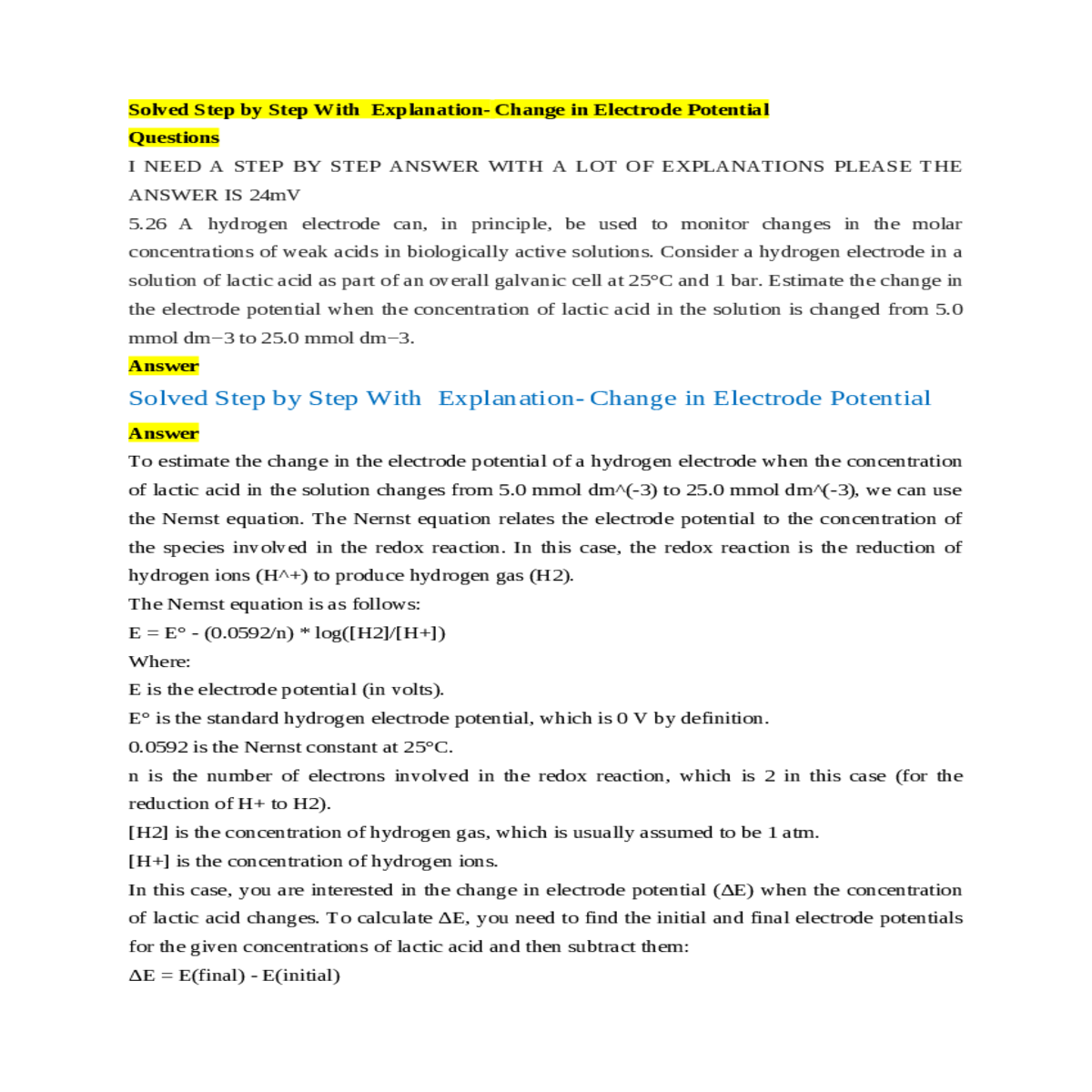
To estimate the change in the electrode potential of a hydrogen electrode when the concentration of lactic acid in the solution changes from 5.0 mmol dm^(-3) to 25.0 mmol dm^(-3), we can use the Nernst equation. The Nernst equation relates the electrode potential to the concentration of the species involved in the redox reaction. In this case, the redox reaction is the reduction of hydrogen ions (H^+) to produce hydrogen gas (H2).
E° is the standard hydrogen electrode potential, which is 0 V by definition.
0.0592 is the Nernst constant at 25°C.
ΔE = E(final) - E(initial)
Let's calculate this step by step:
E_initial = 0 V - (0.0592/2) * log([H2]/[H+]_initial)
Since [H2] is usually assumed to be 1 atm:
Using the Nernst equation:
E_final = 0 V - (0.0592/2) * log(1/[H+]_final)
E_initial = -0.0592 * log(1/[H+]_initial)
E_initial = -0.0592 * log(1/(5.0 x 10^(-3)))
E_final = -0.0592 * log(1/[H+]_final)
E_final = -0.0592 * log(1/(25.0 x 10^(-3)))
ΔE = E_final - E_initial
ΔE = (-0.0950 V) - (-0.1360 V)