Calculating power factor, impedance, voltage, and capacitor value Homework Answers Needed
Your Question:
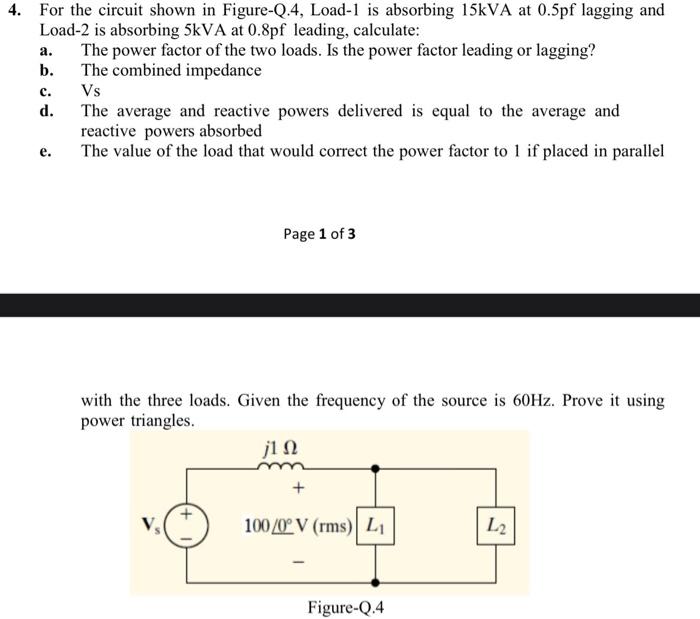
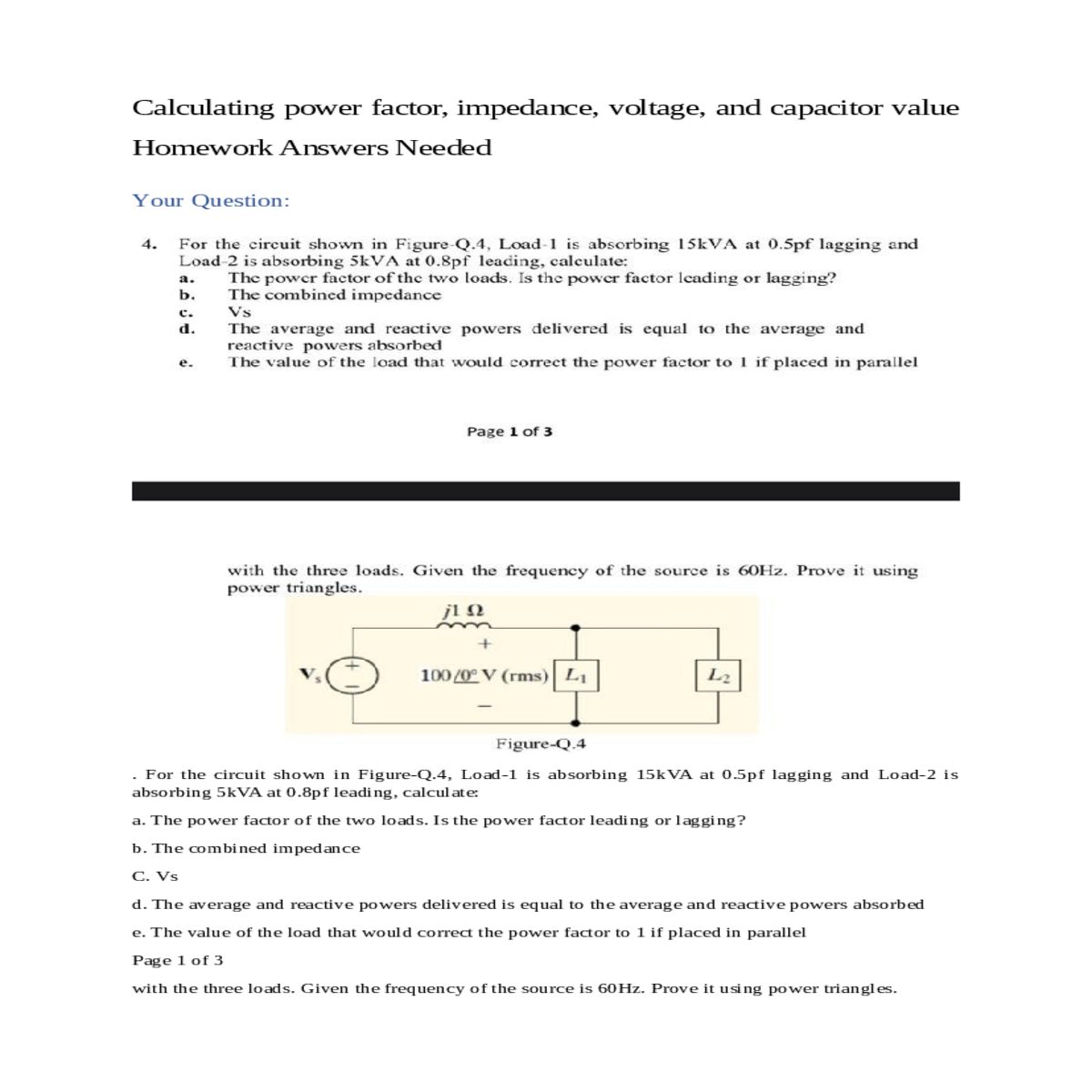
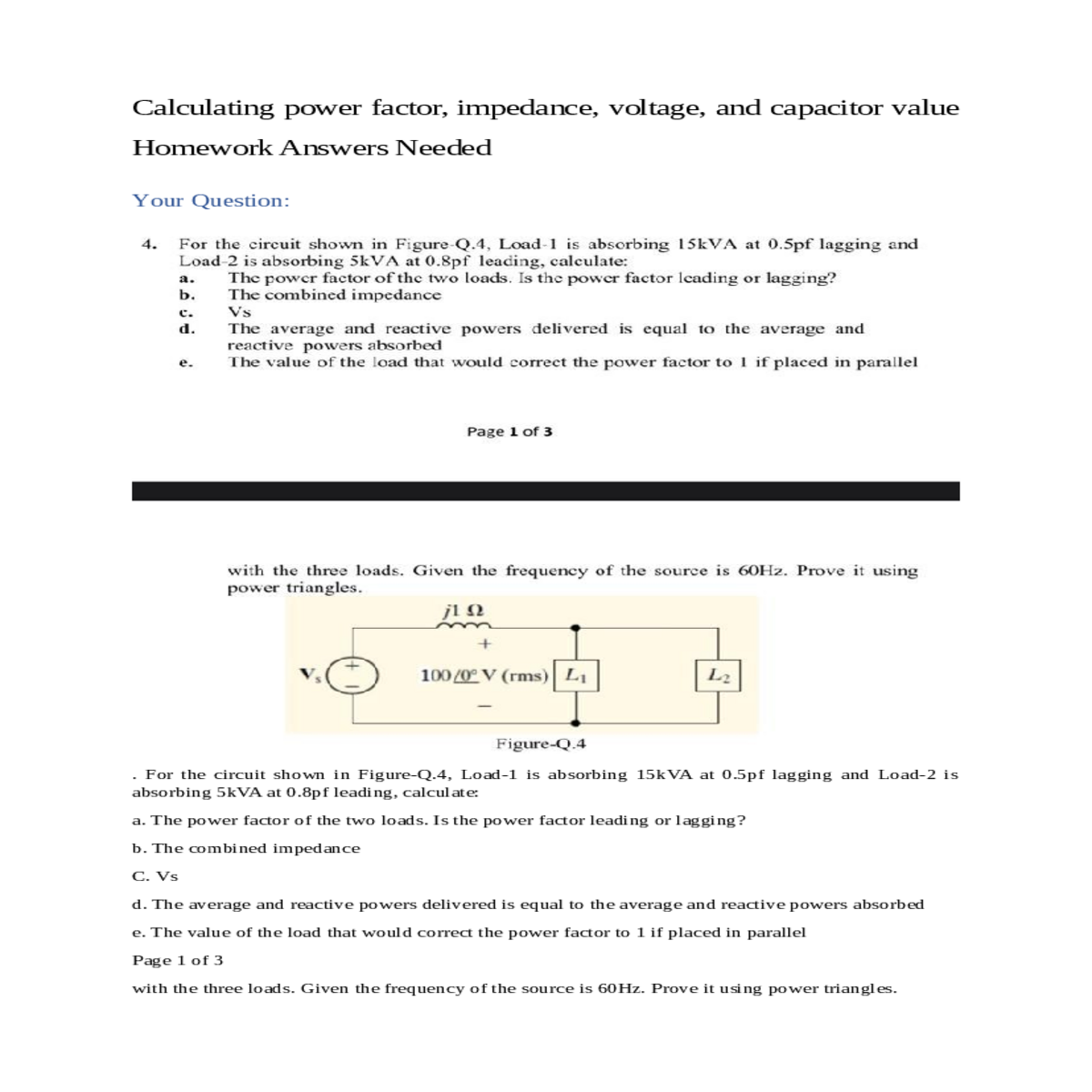
. For the circuit shown in Figure-Q.4, Load-1 is absorbing 15kVA at 0.5pf lagging and Load-2 is absorbing 5kVA at 0.8pf leading, calculate:
a. The power factor of the two loads. Is the power factor leading or lagging?
Page 1 of 3
with the three loads. Given the frequency of the source is 60Hz. Prove it using power triangles.
Step By Step Answers with Explanation
PF is the power factor
P1 and P2 are the real powers of the two loads
We can then calculate the total real power and total apparent power as follows:
P = P1 + P2 = 7.5kW + 4kW = 11.5kW
b. The combined impedance
To calculate the combined impedance of the two loads, we can use the following formula:
We know that Load-1 is absorbing 15kVA at 0.5pf lagging and Load-2 is absorbing 5kVA at 0.8pf leading. We can calculate the impedances of the two loads as follows:
Z1 = S1 / PF1 = 15kVA / 0.5 = 30Ω
C. Vs
To calculate the voltage Vs, we can use the following formula:
I is the current
We know that the combined impedance of the two loads is 13.3Ω. We can calculate the current as follows:
We know that the total real power is 11.5kW. We can now calculate the voltage Vs as follows:
Vs = Z * I = 13.3Ω * (11.5kW / Vs)
The average power delivered to the two loads is equal to the average power absorbed by the two loads. This is because the average power is the real power, and the real power is conserved in a circuit.
The reactive power delivered to the two loads is equal to the reactive power absorbed by the two loads. This is because the reactive power is not dissipated in the circuit, but is instead circulated between the source and the loads.