But the disadvantages outweigh the advantages pts dif obj
CHAPTER 4—MOTIVATIONAL PRINCIPLES AS APPLIED TO SUPERVI-
SION
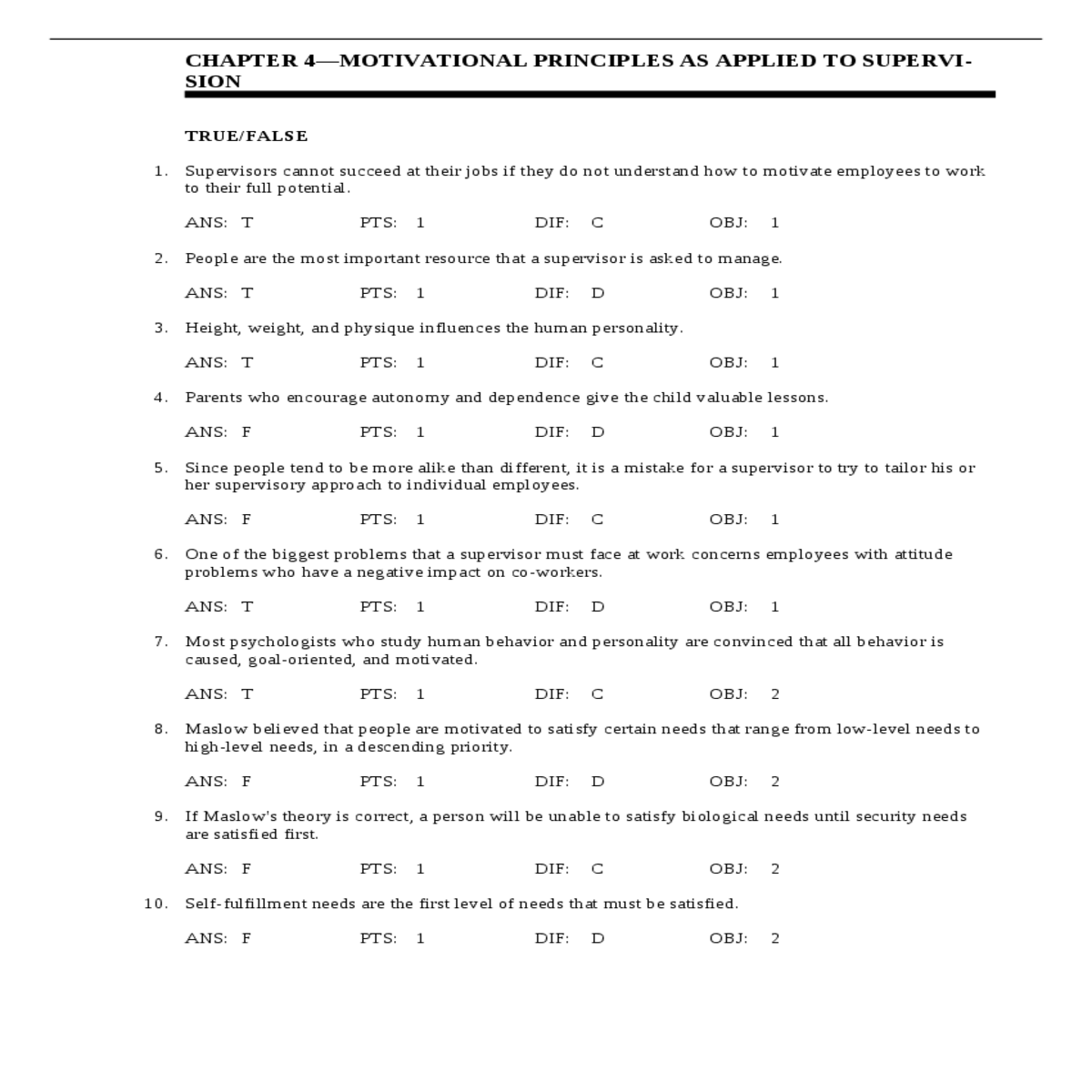
2. People are the most important resource that a supervisor is asked to manage.
ANS: T PTS: 1 DIF: D OBJ: 1
5. Since people tend to be more alike than different, it is a mistake for a supervisor to try to tailor his or
her supervisory approach to individual employees.
7. Most psychologists who study human behavior and personality are convinced that all behavior is
caused, goal-oriented, and motivated.
9. If Maslow's theory is correct, a person will be unable to satisfy biological needs until security needs
are satisfied first.
| 10. | PTS: | DIF: | C | OBJ: | |||
|---|---|---|---|---|---|---|---|
|
|||||||
|
PTS: | DIF: | D | OBJ: | |||
12. Successful supervisors reward employees based on which needs are currently driving the employee.
ANS: T PTS: 1 DIF: A OBJ: 2
15. Challenging or interesting work and recognition for accomplishments are examples of hygiene factors.
ANS: F PTS: 1 DIF: C OBJ: 2
ANS: F PTS: 1 DIF: D OBJ: 2
18. According to expectancy theory, employees must be able to perceive a relationship between the effort
possible standard.
ANS: F PTS: 1 DIF: C OBJ: 2
21. According to equity theory, employees perform better when they believe that their efforts lead to de-
sired rewards.
23. The best way for a supervisor to handle difficult employees is simply to ignore them.
ANS: F PTS: 1 DIF: C OBJ: 3
ANS: T PTS: 1 DIF: D OBJ: 4
26. When Joe showed up late to work for the third time his supervisor cut him a break by writing him up
ANS: T PTS: 1 DIF: D OBJ: 5
28. According to Theory Y, employees must be threatened or coerced to get them to accomplish their
30. Theory X is the better approach to supervisoring employees when tasks must be accomplished quickly.
ANS: T PTS: 1 DIF: A OBJ: 5
ANS: T PTS: 1 DIF: D OBJ: 6
33. Job enlargement does not result in improved employee performance.
35. Job rotation is when a supervisor assigns challenging tasks and gives the employee more decision-
making responsibilities.
those decisions.
ANS: T PTS: 1 DIF: C OBJ: 6
MULTIPLE CHOICE
1. Which of the following influences of early childhood has a lifelong influence?
ANS: C PTS: 1 DIF: D OBJ: 1
2. Which of the following is NOT included in Maslow’s Hierarchy of Needs:
ANS: B PTS: 1 DIF: C OBJ: 1
3. Which of Maslow’s Hierarchy of Needs is the first and most important?
ANS: A PTS: 1 DIF: C OBJ: 2
4. The least important of Maslow's hierarchy is:
ANS: A PTS: 1 DIF: C OBJ: 2
5. As the head of a one-parent household, Henrietta must make certain that she and her children are
c. Safety.
d. Self-fulfillment.
c. "You’re lucky you still have a job with this company.”
d. "If we close this deal, you will be recognized by top management.”
c. Motivation factors.
d. Hygiene factors.
c. Supervision.
d. Money.
c. Herzberg believed that employees are not particularly motivated by lower-level needs.
d. Maslow believed that employees are not particularly motivated by lower-level needs.
b. It should be given in private so as not to cause jealousy among the rest of the staff.
c. It should be tied primarily to an employee's status and seniority.
b. Suggests that employees are motivated by higher-order needs only after lower-level needs
have been satisfied.
12. Simon and Diana perform the same work. They are each paid the same, but Simon believes that Diana
is paid more. In this case:
work.
ANS: A PTS: 1 DIF: A OBJ: 2
c. It helps supervisors determine which employees are the most productive.
d. It encourages supervisors to find out what employees want and need and see as just and
b. Always take time to listen to their side of the story.
c. Threaten to transfer them to another department.
employee.
b. The best way for an employee to learn what is expected on the job is by trial and error.
16. The process of making behavior occur less frequently because it is linked to an undesirable con-
sequence is called:
b. It takes more of a supervisor’s time than Theory Y management.
c. It is almost always better to use than Theory Y management.
b. It is often resented by employees.
c. It does not promote or allow personal growth for the employee.
b. Skill variety.
c. Autonomy.
b. Task identity.
c. Task significance.
b. Job rotation.
c. Job enrichment.
a. Job rotation.
b. Job enlargement.
a. Emmanuel solicits suggestions from his staff on the best way to meet an important dead-
line.
| PTS: |
|
DIF: |
|
OBJ: |
|---|
Personality is the complex mix of knowledge, attitudes, and attributes that distinguish one person from
all others. The four primary determinants of personality are physiological factors, early childhood in-
Physiological needs are the necessities in life (i.e., food, water, and shelter); therefore, they are more
important than any other need outlined by Abraham Maslow.
ability to improve employee performance.
PTS: 1 DIF: A OBJ: 2
ployees and their concerns and then must establish expected behaviors for employees as well as the
deadlines and timetables within which the improvement must occur. It is ultimately the supervisor’s
Task significance: the degree to which the job impacts the lives or work of others.
Autonomy: the amount of independence, freedom, and discretion an employee has in making decisions
ANS:
Theory X techniques might be employed in times of crisis, when time is of the essence, or when other
occur?
ANS:
| PTS: | DIF: |
|
OBJ: |
|
|---|
In Maslow’s Hierarchy of Needs Theory, physiological needs, safety needs, and belonging needs can
be related to Herzberg’s hygiene factors. For example, money is a hygiene factor that would probably
would be a true motivator, and would be representative of the self-actualization level on Maslow’s
hierarchy.