

Bolts and screw machine products oil field machinery and tools
Domestic Production and Foreign Trade; The American Capital Position Re-Examined Author(s): Wassily Leontief
Source: Proceedings of the American Philosophical Society, Vol. 97, No. 4 (Sep. 28, 1953), pp.Each copy of any part of a JSTOR transmission must contain the same copyright notice that appears on the screen or printed page of such transmission.
JSTOR is a not-for-profit service that helps scholars, researchers, and students discover, use, and build upon a wide range of content in a trusted digital archive. We use information technology and tools to increase productivity and facilitate new forms of scholarship. For more information about JSTOR, please contact support@jstor.org.

DOMESTIC PRODUCTION AND FOREIGN TRADE; THE AMERICAN CAPITAL POSITION RE-EXAMINED1
French Cookbook by Tante Marie
I. THE STRUCTURAL BASIS OF
INTERNATIONAL TRADE
2 As an example of the recent empirical studies in that
1The study described in this paper constitutes a part
This is the first preliminary progress report on
a study designed to analyze the structural basis of
trade relationships between the United States and
the rest of the world.II. DIRECT AND INDIRECT INPUT
The more minute the breakdown of industries
in the basic input-output table, the more detailed the final results will be. The following analysis is based on a 200 industry breakdown consolidated in some of its stages-for purposes of computation and simplified presentation-into fifty sectors (38
| s I |
|---|
|
of dollars) | (Man years) |
|---|
Total requirements in all industries per million dollars of final output of motor vehicles
VOL. 97, NO. 4, 1953] DOMESTIC PRODUCTION AND FOREIGN TRADE
of which trade their products directly on the inter-
inventories of raw materials and "goods in proc- ess" by 124 thousand dollars. All together this adds up to 566 thousand dollars which represent the total additional capital (in 1947 prices) which would have to be invested in the American auto-
mobile industry if its capacity were raised so as to enable us to produce an additional million dollars' worth of cars per year.
The figures entered in columns 2 and 3 were
The main reason for such a two-stage procedure is economic. If based throughout on the 200 x 200 input-output table the computation of direct and indirect requirements would cost a thousand dollars more. The errors caused by the short cut are not likely to be of decisive importance since
|
|---|
of total
1,617 ,910
| d See text, page 335, for the derivation | of these figures. |
|
|---|
| Some of the 200-order industries | were split in the process of aggre- | as export items. | |||
|---|---|---|---|---|---|
| 200-order industry | SIC No. | port value, i.e., foreign port value plus transpor- | |||
| The basic data on the direct capital requirements | (capital coefficients) |
|
which probably | did not include operations |
|---|
19. Other fabricated metal products
Steel springs (108)
Nuts, bolts and screw machine products (109)
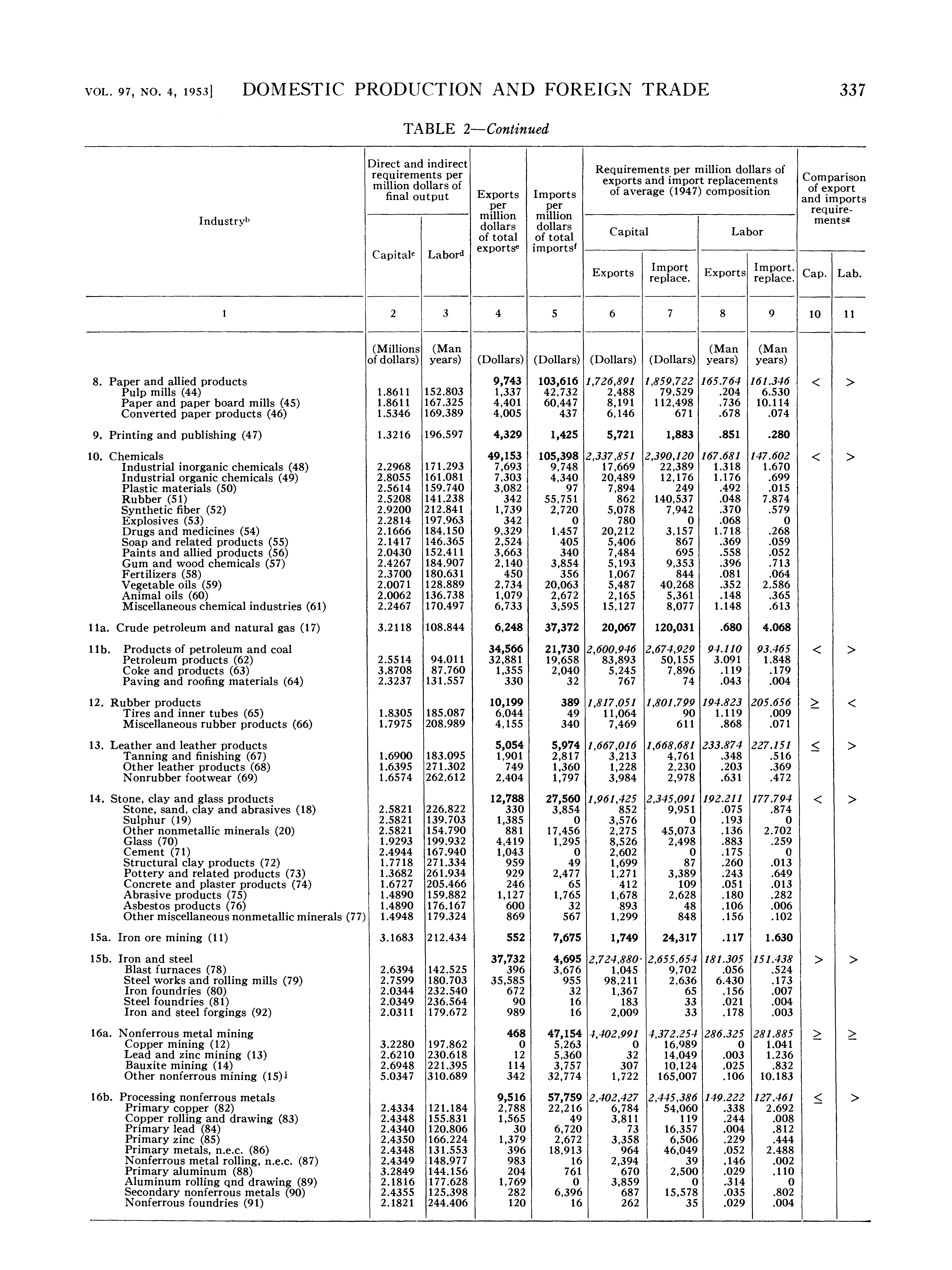
TABLE 2-Continued
Direct and indirect
29. Miscellaneous manufacturing (157-163)
30. Coal, gas and electric power
Coal mining (16)
Electric light and power (167)
Natural, manufactured and mixed gas (168)
31. Railroad transportation (169)
32. Ocean transportation (172)
33. Other transportation
34. Trade
Wholesale trade (176)
Retail trade (177)
| - | // | 5 9 | / | 6 0 |
|
1 1 2 8 1 | 1 1 4 | 1 0 3 |
|---|
| if |
|---|
_ 2.25
!
) 2.
ion and foreign trade, Proc. Amer. Philos. Soc. 97: (4): 340-341, 1953.
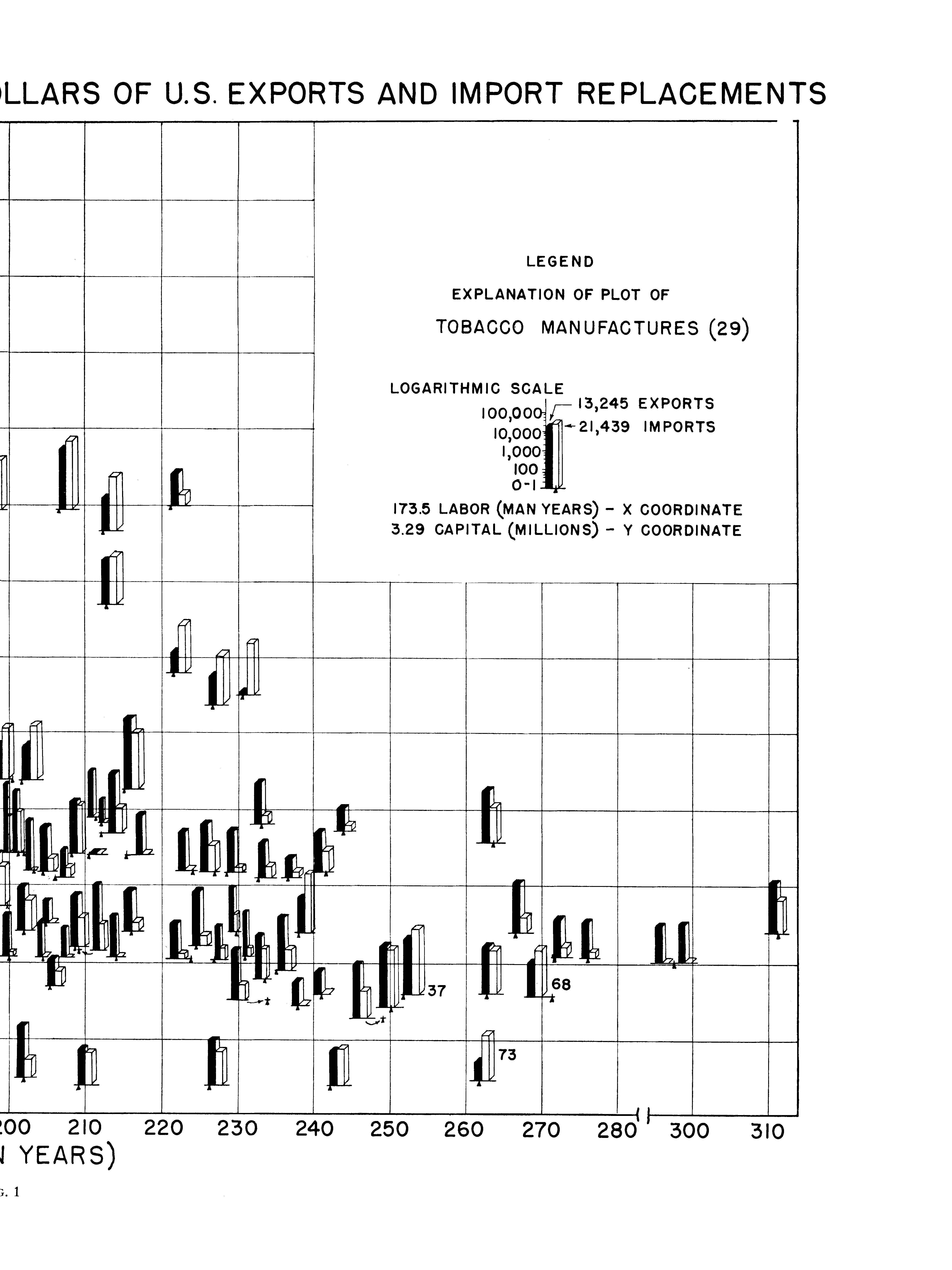
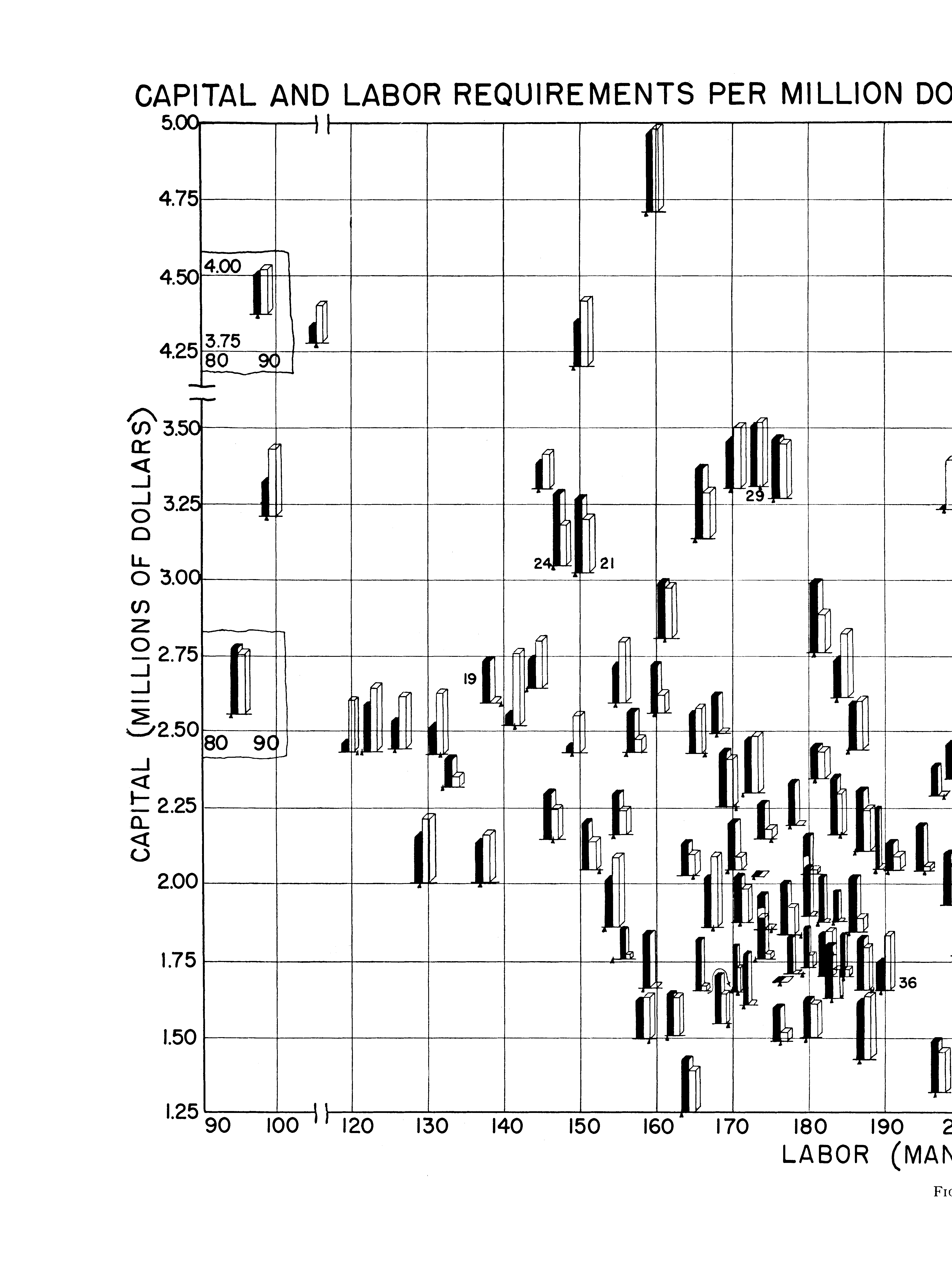
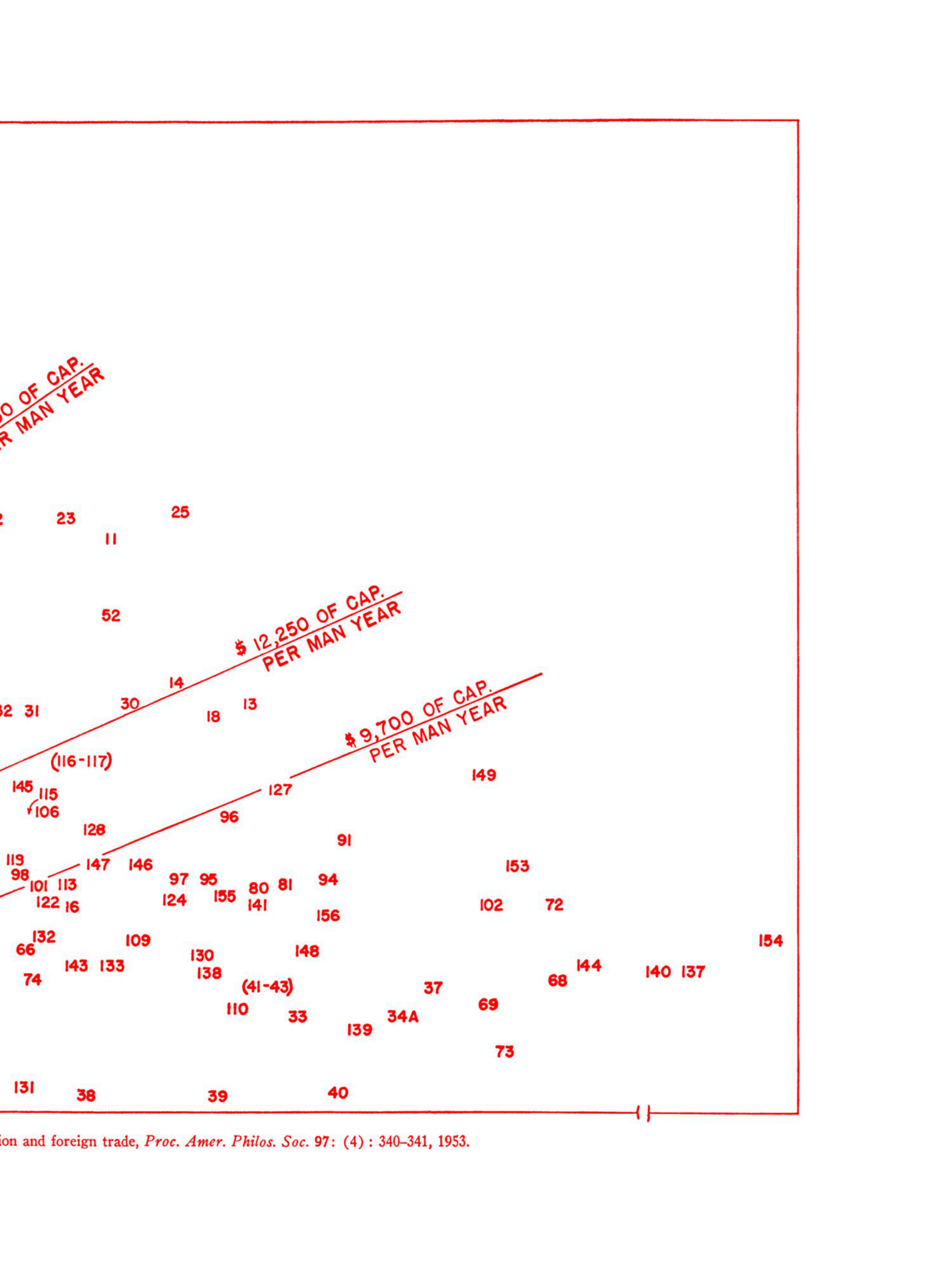
ILLARS OF U.S. EXPORTS AND IMPORT REPLACEMENTS
EXPLANATION OF PLOT OF
WASSILY LEONTIEF
other, minor items, is assumed to remain at the
| To replace a million dollars' worth of imports | Evans and Hoffenberg, ibid.) | The results of these origi- |
|---|
thus present the United States' imports as depending on the level of final demand which, in particular, itnplies that any rise in exports would necessarily require an increase in imports.
For the purposes of the present analysis, this conclusion
6 and 8, respectively.
V. EMPIRICAL FINDINGS AND THEIR
observation is that the United States possesses
| With the typical competitive imports-such | as cars, |
|
|
|---|---|---|---|
| tion is entirely different. | If the problem of comparative | ||
1947 COMPOSITION)
be quite small. It was still, however, taken into account
Our data obviously cannot explain why Ameri-
and twenty thousand dollars' worth of equipment,
The extent to which the high relative efficiency
The fact that workers are frequently replaced
7 To clarify the internal logic of the argument leading
to this assertion, let us consider-from the point of view
From the point of view of sheer arithmetic, the
unusual situations, this decision could and would be made
without any regard to the actual distribution of the com-
bined labor and capital resources of the world between the
different countries. This distribution could be taken into
It is particularly important to observe that under the
Before directing your attention to the wider
| all the countries. |
|---|
A visual presentation of the quantitative rela-
The results of this visual examination are sub-
stantiated by the following numerical compilation.
* Turnover within the line segments is not exactly
lars due to rounding and the omission of the Other Non-
ferrous Mineral Mining industry--f. footnote f, table 2.To facilitate the identification of all the indi-
worth of the average combination of exportable