Stable, exhibiting damped Assignment Answers Needed
Your Question:
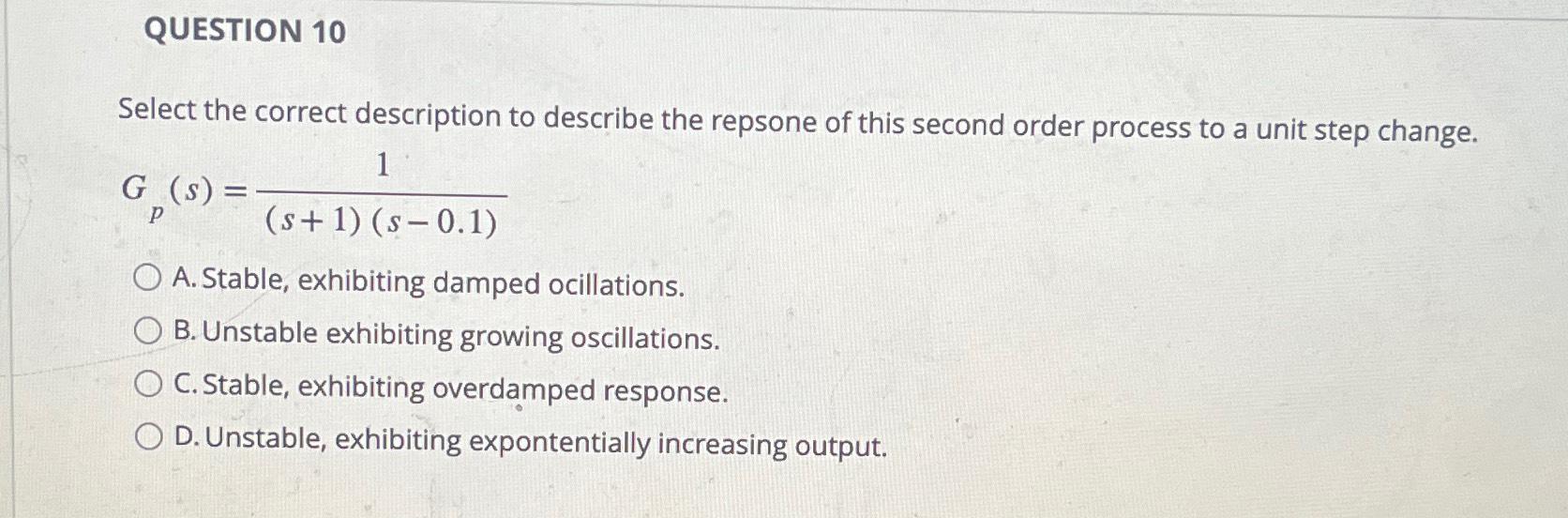
QUESTION 10
Select the correct description to describe the response of this second order process to a unit step change.
D. Unstable, exhibiting exponentially increasing output.
 Step By Step
Answers with Explanation
Step By Step
Answers with Explanation
Step-by-step analysis of the second order process response to a unit step change
Image:
Step 1: Determine the poles and zeros of the transfer function
The poles of the transfer function are located at the roots of the denominator, which are s=−1 and s=0.1. The zeros of the transfer function are located at the roots of the numerator, which is s=0.
If one pole is in the left half of the s-plane and the other pole is in the right half of the s-plane, the system is marginally stable.
In this case, both poles of the system are in the left half of the s-plane, which means that the system is stable.
If the damping ratio is greater than 1, the system will exhibit an underdamped response.
To determine the damping ratio of the system, we can use the following equation:
Since the damping ratio is greater than 1, the system will exhibit an underdamped response.
Conclusion:
450-word explanation of the second order process response to a unit step change
A unit step change is a sudden change in the input to a system. For example, a unit step change in the input to a voltage follower circuit would be to suddenly apply a voltage to the input of the circuit.
How does a second order process respond to a unit step change?
Example of a second order process response to a unit step change
Consider the following second order transfer function: